How Long Does a Dental Crown Last? Lifespan Guide 2026
You invested $1,200 to $2,500 in a dental crown. Now you want to know how long it should actually last before you're back in the chair paying for another one. The honest answer: how long does a dental crown last depends less on the material your dentist picked and more on what happens in your mouth every day after placement.
Most crowns last 10 to 20 years. The average sits right around 15. That's a wide range, and where your crown falls on it depends on your bite, your hygiene, whether you grind at night, and whether decay forms quietly underneath where you can't see it.
This guide gives you the real lifespan data by material, the warning signs that your crown is failing, and the practical steps that add years to a restoration. At Willow Family Dentistry in Wylie, TX, Dr. Esther Jeong checks every existing crown during routine visits so problems get caught early, not after they fail.
Is Your Crown Still in Good Shape?
Dr. Jeong checks your existing crowns during every cleaning, including margin integrity, bite alignment, and signs of hidden decay.
Request a Crown Check →How Long Does a Dental Crown Really Last?
How long does a dental crown last in real patient mouths? Most clinical studies put the average lifespan at 10 to 15 years, with well-placed zirconia and gold crowns regularly lasting 20 years or more. The ADA's MouthHealthy resource on crowns confirms that lifespan varies based on material, oral hygiene, and personal habits more than on brand or technique alone.
Here's what those numbers actually mean. A crown "lasting" 15 years doesn't mean it fails precisely at year 15. It means that's the median point where enough patients need repair or replacement that it shows up in the data. Plenty of crowns go 25 years without trouble. Others fail in 5. The variables are what separate the two.
Material matters, but it's rarely the biggest factor. A gold crown placed on a patient who grinds every night might last 12 years. The same gold crown in a patient who wears a night guard could last 30. Same tooth, same dentist, same material, vastly different outcomes.
Clinical Averages
Crown Lifespan Range at a Glance
Typical Range
10-20
years
Average
~15
years
Best Case
25-30+
years
Some patients at our Wylie practice still have crowns placed in the 1990s that are holding up fine. Others need a redo within 7 years because a small cavity formed at the margin and wasn't caught early. The gap between those outcomes is entirely about what happens between placements.
Which Crown Material Lasts the Longest?
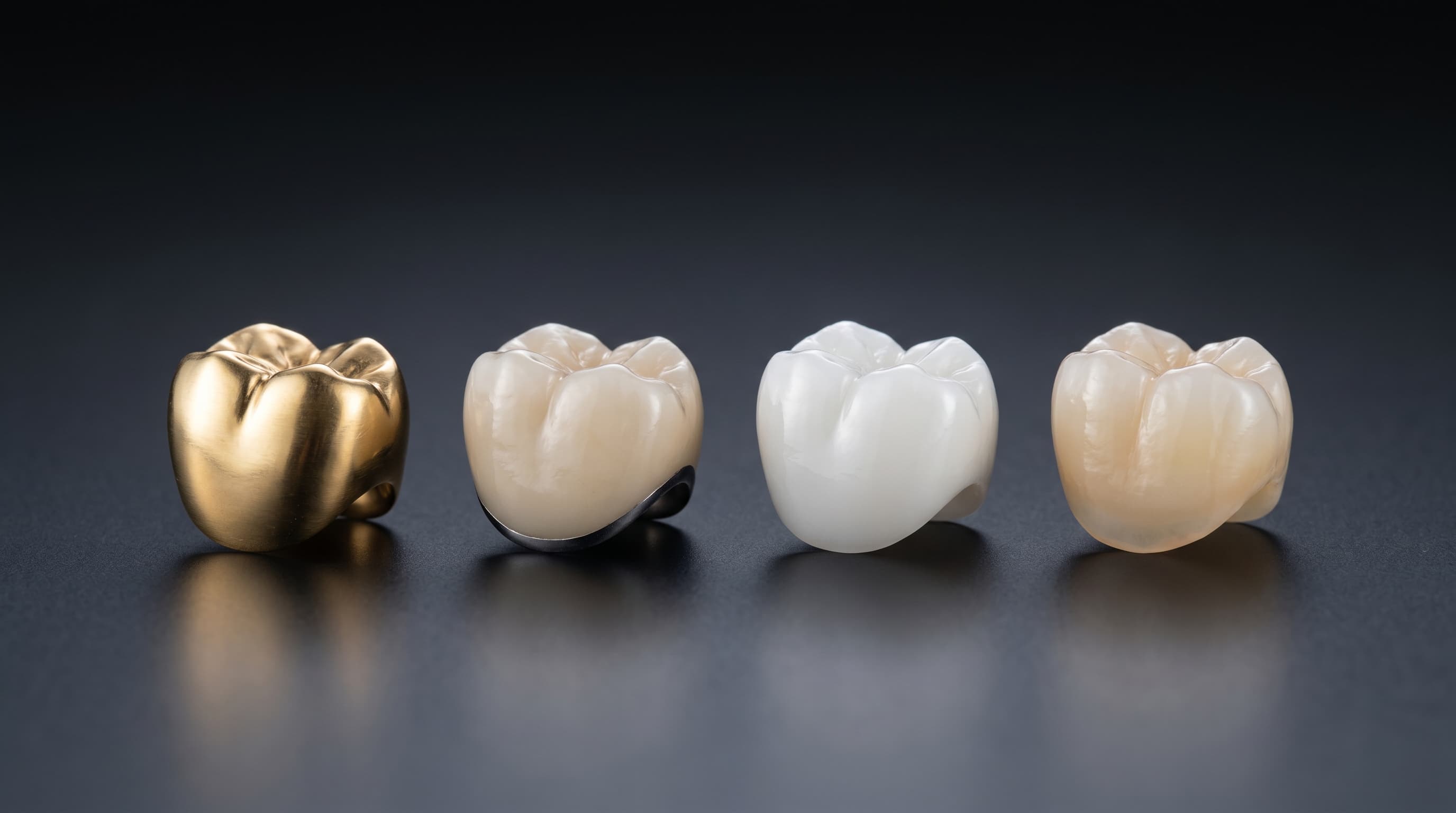
Gold and monolithic zirconia crowns last the longest, with clinical averages of 15 to 20 years or more. Porcelain-fused-to-metal averages 10 to 15 years, and all-ceramic porcelain sits in the same 10 to 15 year range. Material choice matters, but it matters most when paired with the right tooth location and the right patient habits.
| Material | Average Lifespan | Best Case | Common Failure Mode |
|---|---|---|---|
| Gold alloy | 20 to 30 years | 40+ years | Margin wear, rarely fracture |
| Monolithic zirconia | 15 to 20 years | 25+ years | Cement failure, decay at margin |
| Porcelain-fused-to-metal | 10 to 15 years | 20 years | Porcelain chips, metal line shows |
| All-ceramic porcelain | 10 to 15 years | 20 years | Fracture, chipping under load |
| E-max (lithium disilicate) | 10 to 15 years | 20 years | Fracture under heavy bite force |
Gold still wins for pure durability, but almost nobody picks it for a visible tooth anymore. Zirconia has taken over because it combines gold-level strength with natural appearance. That's why Dr. Jeong recommends it for most back molars at our Wylie practice.
For a detailed breakdown of zirconia versus porcelain by cost, durability, and appearance, see our cluster guide on zirconia vs porcelain crowns. For the complete pricing picture across all materials and insurance scenarios, check our main guide on dental crown cost Texas patients can expect in 2026.
What Shortens a Crown's Lifespan?
Four things cut crown life short more than any other: chronic teeth grinding, decay forming at the margin where the crown meets your tooth, poor bite alignment that puts uneven pressure on the restoration, and weak cementation during the original placement. Get those four right, and most crowns outlast their expected lifespan.
Grinding is the most common killer. Roughly 1 in 4 American adults has some form of bruxism, per CDC dental data. Over time, grinding flattens the biting surface, creates microcracks, and can shatter an otherwise well-made crown. The Mayo Clinic documents that chronic bruxism damages both natural teeth and restorations, which is why a night guard is often recommended alongside any new crown.
Margin decay is the silent killer. A crown seals a tooth against bacteria, but only if the margin stays intact. Tiny gaps can form over the years from normal wear, from cement breakdown, or from inadequate fit at placement. Bacteria slip in, decay starts, and by the time you feel pressure or sensitivity, the tooth underneath may already be compromised.
Lifespan Killers
Four Things That Shorten Any Crown
1. Chronic grinding or clenching
Creates microcracks and fracture risk over time
2. Decay forming at the crown margin
Silent killer, often only caught on 6-month checkups
3. Uneven bite or occlusal misalignment
Puts repeated pressure on one spot of the crown
4. Weak or aged cement bond
Crown becomes loose, allowing bacteria underneath
The fourth factor, cementation, is the one patients can't control. It comes down to the dentist's technique on the day of placement. A crown cemented on a damp or contaminated tooth surface will fail earlier than one placed under ideal conditions. This is one reason why corporate chain production models can shorten crown life, since the time pressure often compromises the detail work.
Get an Honest Assessment of Your Existing Crowns
We check margin integrity, bite alignment, and cement bond on every crown during routine visits. No pressure to replace what's still working.
Contact Our Team →How Do You Know When a Crown Needs Replacing?
A crown needs replacement when you notice a dark line at the gumline, persistent pain or sensitivity on biting, visible chipping or cracking, looseness when you press on it, receding gums exposing the margin, or a change in how your bite feels. Any one of these means an exam, not a wait-and-see approach.
7 Warning Signs Your Crown Is Failing
- Dark line at the gumline. Usually signals metal exposure on a porcelain-fused-to-metal crown, or decay forming underneath.
- Pain when biting down. Often indicates a crack, a loose crown, or infection in the tooth beneath.
- Temperature sensitivity. New sensitivity to hot or cold after years of comfort suggests a failing seal at the margin.
- The crown feels loose. Cement has broken down. Bacteria are likely under the crown already.
- Visible chip or crack. Even a hairline fracture can progress quickly under normal chewing force.
- Gum recession around the crown. Exposes margins that used to be hidden, making decay and staining more likely.
- Your bite feels different. The crown may have worn down, shifted, or the tooth beneath has changed position.
The cost question matters here. Replacing a single crown in Texas runs $1,000 to $2,500, depending on material and whether a new buildup or post-and-core is needed. For the full replacement cost breakdown, see our guide on dental crown cost Texas families budget for in 2026.
What you want to avoid is a failed crown left untreated. Bacteria reaching the tooth root can cause an abscess, which then requires a root canal or extraction. That's when a $1,500 replacement turns into a $4,000 implant. Regular dental visits catch roughly 80% of oral health issues before they become structural problems, per ADA Health Policy Institute research, and crown margins are one of the things your hygienist checks every visit.
Related: Wondering if same-day crowns are an option for a replacement? → How CEREC Same-Day Crowns Work in Wylie, TX
Can You Extend the Life of a Dental Crown?
Yes. Four habits consistently add years to any crown: wearing a custom night guard if you grind, keeping your 6-month hygiene visits without skipping, brushing gently along the crown margin with a soft-bristle brush, and flossing the crown every day with the right technique. None of these are dramatic. All of them work.
A night guard alone can add 5 to 10 years to a crown's life if you're a grinder. That's a $300 to $600 appliance protecting a $1,500 to $2,500 restoration. The math makes itself. Dr. Jeong fits a custom night guard for patients at our Wylie practice whenever bruxism history comes up in the exam.
Hygiene visits matter for a different reason. At every 6-month visit, the hygienist checks crown margins with a fine explorer, looking for catch-points that indicate early decay or cement breakdown. Catching a margin issue in month 6 means cleaning and remineralization. Catching it in month 18 often means a full replacement. The cost difference is dramatic.
Americans who visit a dentist regularly are 60% less likely to lose teeth, per Journal of Dental Research data. That same pattern applies to crown longevity. Regular preventive visits protect the restoration you already paid for.
What Patients Commonly Do Wrong
Three habits shorten crown life without patients realizing it. Chewing ice, using teeth to open packages, and flossing too aggressively at the crown margin. Ice is hard enough to crack even zirconia under the right angle. Opening bottles or ripping tape with front teeth puts sideways force on crowns they're not built to absorb. And yanking floss up against the margin can break down the cement bond over time.
The fix is simple. Gentle flossing with a slide-in, slide-out motion instead of a snap. Avoid using teeth as tools. And if you wake with a sore jaw or hear yourself grinding at night, bring it up at your next cleaning. A night guard prescription often takes 10 minutes of exam time and can protect a decade of investment.
Book Your 6-Month Checkup
We check every existing crown during routine visits. Margin, bite, cement, and hidden decay all get a second look.
Schedule Your Visit →Why Willow Family Dentistry Crowns Last Longer in Wylie, TX
Families in Wylie choose our practice because we take the time each crown case deserves, from the initial prep through final cementation. Our crown placements in Wylie, TX are part of a broader restorative approach, and the private practice model gives Dr. Jeong the margin to do each step right.
There's no assembly line. Every crown gets a proper prep, an accurate impression or digital scan, a carefully made temporary, and a shade match when aesthetics matter. Our iCAT 3D imaging lets Dr. Jeong see exactly what's underneath a tooth before prep starts, which reduces remakes and extends the life of the final crown.
Cementation happens under ideal conditions, not rushed between back-to-back appointments. That detail shows up 10 years later in how crowns hold up. Our patients from Murphy, Sachse, Lucas, Allen, and Plano come back twice a year for checkups, which is where we catch the small issues before they become big ones.
If anxiety is part of what keeps you from regular visits, we offer both nitrous oxide and IV sedation. Our multilingual team speaks English, Korean, Spanish, and Vietnamese, so treatment discussions happen in the language you're most comfortable with. Preventive care is the most cost-effective strategy for making any crown last, and every checkup protects the investment you already made.
Protect the Crown You Already Have
Schedule a routine visit with Dr. Jeong. We'll check every existing crown, flag any early warning signs, and help you add years to your restoration.
Request an Appointment →Have questions? We're happy to help.
Call (972) 881-0715 →Dr. Esther B. Jeong, DDS
DDS · Willow Family Dentistry
Wylie family dentist with 15+ years of experience providing gentle, judgment-free dental care.
Frequently Asked Questions
Was this article helpful?
You may also like



Have a dental question?
Schedule a consultation and get personalized answers from Dr. Jeong.
Call us
(972) 881-0715
Hours
Mon – Thu: 9am – 5pm
Fri: By Appointment
Location
1125 W FM 544, Wylie
Emergency? Same-day appointments available.