Geographic Tongue Causes: Why Your Tongue Has Map-Like Patches

If you have ever noticed smooth, reddish patches on your tongue surrounded by slightly raised white or yellowish borders that seem to move or change shape from one day to the next, you have been looking at geographic tongue. The name comes from the appearance: the patches look like the irregular outlines of continents on a map. Geographic tongue causes are well understood, the condition is entirely benign, and most people who have it live with it for years before learning it has a name.
At Willow Family Dentistry in Wylie, TX, Dr. Esther B. Jeong evaluates tongue changes during routine exams and can confirm whether what you are seeing is geographic tongue or something that warrants further investigation.
What Is Geographic Tongue?
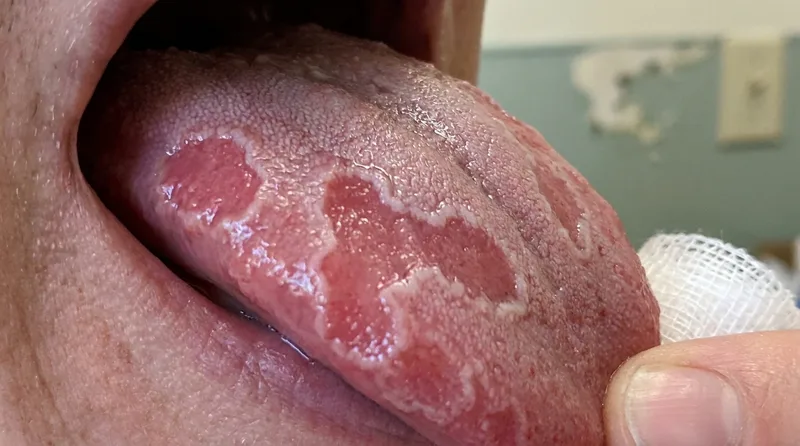
Geographic tongue, clinically called benign migratory glossitis, is a harmless inflammatory condition in which smooth red patches appear on the tongue surrounded by irregular white borders. The patches heal and re-form in different locations over days or weeks, creating the map-like pattern the condition is named for.
Geographic tongue, clinically called benign migratory glossitis, is a harmless inflammatory condition of the tongue surface in which patches of the small taste-sensing projections called filiform papillae are temporarily lost, leaving smooth red areas surrounded by a slightly irregular white or yellowish border. The patches heal and re-form in different locations over days or weeks, which is why the pattern appears to migrate and change, and why the condition was given the "migratory" part of its clinical name.
The condition affects an estimated 1% to 3% of the population, according to published prevalence data, though many cases go unnoticed and unreported because the condition causes no discomfort in a substantial proportion of people who have it. It can appear at any age but is most commonly identified in adults and children rather than in elderly individuals. Geographic tongue is not contagious, is not caused by any virus or bacteria, and does not become cancerous.
According to Healthline, geographic tongue is a benign condition with no known serious complications, and the primary reason patients seek evaluation is either because the appearance concerns them or because certain foods trigger burning or discomfort in the affected areas.
What Causes Geographic Tongue?
The exact cause of geographic tongue is not fully understood, but several factors are consistently associated with it. The condition tends to run in families, which suggests a genetic component. It is also strongly associated with fissured tongue, a separate harmless condition in which the tongue surface has deep grooves or fissures, and the two often appear together.
Factors associated with geographic tongue flare-ups or worsening include stress, hormonal fluctuations particularly in relation to the menstrual cycle, certain dietary triggers, and in some individuals, allergic conditions including asthma and atopic dermatitis. Nutritional deficiencies, particularly in zinc, iron, and B vitamins, have also been associated with geographic tongue in some patients, though the relationship is not fully established.
The condition is not caused by poor oral hygiene, not related to any sexually transmitted infection, and not a sign of any systemic disease in the vast majority of people who have it. Research published in the dental literature has found that geographic tongue occurs at higher rates in patients with psoriasis, suggesting a shared inflammatory pathway between the two conditions, according to that evidence, though geographic tongue itself requires no medical management beyond monitoring.
What Does Geographic Tongue Feel Like?
Many people with geographic tongue experience no symptoms at all and discover the condition only when a dentist or someone else points it out. When symptoms do occur, the most common is a burning, stinging, or heightened sensitivity in the affected areas, particularly in response to certain foods and beverages.
Common triggers for geographic tongue discomfort include hot or spicy foods, acidic foods and beverages such as citrus, tomatoes, and vinegar, salty foods, and toothpastes containing sodium lauryl sulfate or strong flavoring agents. The sensitivity is typically localized to the smooth denuded areas rather than the entire tongue, and it resolves as those areas re-epithelialize over days.
Pain or burning that is severe, persistent, or spreading beyond the tongue warrants evaluation. Geographic tongue discomfort is typically mild, intermittent, and clearly associated with specific food triggers. Pain that does not fit that pattern should be evaluated to rule out other causes.
How Is Geographic Tongue Diagnosed?
Geographic tongue is diagnosed clinically by its appearance. A dentist or physician who is familiar with the condition can identify it visually in most cases without any testing. The characteristic combination of smooth red patches, irregular white borders, and a migrating pattern over time makes the diagnosis straightforward in typical presentations.
If the appearance is atypical, if the lesions do not migrate, or if there are other clinical features that raise concern, additional evaluation may include blood tests to assess for nutritional deficiencies or a biopsy to confirm the diagnosis histologically. In practice, biopsy is rarely needed for geographic tongue with a classic presentation.
The condition most commonly confused with geographic tongue is oral candidiasis, a fungal infection that can also produce irregular white patches on the tongue. Candidiasis patches typically wipe off when rubbed, leaving a red or bleeding base, while geographic tongue patches do not. Other conditions that can produce tongue surface changes include lichen planus, vitamin deficiencies, and in rare cases, oral cancer. This is why any persistent tongue change that is new, growing, or unusual warrants a dental evaluation rather than self-diagnosis.

Is Geographic Tongue Related to Other Conditions?
Geographic tongue is associated with several other conditions at higher rates than would be expected by chance. The strongest association is with fissured tongue, which co-occurs in a majority of geographic tongue cases according to published research. An association with psoriasis has also been documented, and some research suggests connections with atopic conditions including asthma and eczema.
These associations do not mean that geographic tongue causes or predicts any of these conditions, nor that having geographic tongue requires any investigation into systemic disease in the absence of other symptoms. The associations are noted in the research literature but the clinical significance for individual patients without other symptoms is minimal. According to the American Dental Association, most oral soft tissue findings that appear benign on examination can be monitored at routine dental visits rather than requiring specialist referral or further workup in the absence of worrying features.
When Is a Tongue Change Something Other Than Geographic Tongue?
Features suggesting a tongue lesion may not be geographic tongue include patches that do not move or change over weeks, a lesion that is growing, constant pain not linked to food triggers, firmness beneath the surface, or any lesion accompanied by swollen neck lymph nodes. These warrant evaluation.
While geographic tongue is benign and requires no treatment, it is important to distinguish it from tongue changes that do warrant evaluation. Features that suggest a tongue lesion may not be geographic tongue include patches that do not move or change over weeks, a lesion that is growing or becoming more distinct rather than migrating, pain that is constant rather than triggered by specific foods, any firmness or induration beneath the surface, and any lesion accompanied by swollen lymph nodes in the neck.
Oral cancer can present as a red or mixed red and white patch on the tongue that does not heal, and the distinction from geographic tongue is important enough that any uncertain tongue lesion should be evaluated rather than assumed to be the benign condition. Dr. Jeong performs an oral cancer screening as part of every comprehensive exam at Willow Family Dentistry, which provides the ongoing monitoring needed to catch any lesion that changes character over time.
Our article on what your tongue reveals about your health covers the broader range of tongue surface changes and what each pattern typically indicates, and our article on cold sore vs canker sore covers the soft tissue changes most commonly confused with geographic tongue by patients self-diagnosing.
Is There Treatment for Geographic Tongue?
Geographic tongue has no specific treatment because it is a benign self-limiting condition that requires none. Practical management involves identifying food triggers and avoiding them during flare-ups. Switching to a toothpaste without sodium lauryl sulfate can reduce irritation for some patients.
Geographic tongue has no specific treatment because it is a benign self-limiting condition that requires none. For patients who experience discomfort with certain foods, the practical management is identifying and temporarily avoiding those triggers during active flare-ups. Switching to a toothpaste that does not contain sodium lauryl sulfate can reduce tongue irritation for some patients, as that ingredient is a known mucosal irritant.
If nutritional deficiency is suspected and blood work confirms a deficiency in zinc, iron, or B vitamins, addressing the deficiency can reduce the frequency or severity of geographic tongue episodes in susceptible individuals, though this does not apply to all patients. For patients whose discomfort is significant during flare-ups, a dentist can discuss options for temporary symptom management. No intervention changes the underlying tendency toward geographic tongue, which typically persists throughout life with variable periods of activity and relative remission.
The reassuring aspect of geographic tongue is that it requires nothing more than awareness. Patients who know what they are looking at are far less likely to spend years unnecessarily concerned about a harmless variation in tongue appearance, which is the main reason explaining geographic tongue is a routine part of the dental exam conversation at Willow Family Dentistry.
Noticed changes on your tongue?
Book an evaluation at Willow Family Dentistry in Wylie, TX. Dr. Jeong will confirm whether what you are seeing is geographic tongue and let you know if any follow-up is needed.
Explore preventive dentistryFurther Reading
Geographic tongue is one of several soft tissue topics covered at Willow Family Dentistry.
- Canker Sore Causes, Triggers, and How to Heal Faster
- Dental Fluorosis: White Marks From Too Much Fluoride
- Tartar vs Plaque: The Difference and Why It Matters
Results may vary. Please consult with Dr. Jeong for personalized treatment recommendations.
Dr. Esther B. Jeong, DDS
DDS · Willow Family Dentistry
Wylie family dentist with 15+ years of experience providing gentle, judgment-free dental care.
Frequently Asked Questions
Was this article helpful?
You may also like



Have a dental question?
Schedule a consultation and get personalized answers from Dr. Jeong.
Call us
(972) 881-0715
Hours
Mon – Thu: 9am – 5pm
Fri: By Appointment
Location
1125 W FM 544, Wylie
Emergency? Same-day appointments available.