Tooth Notch Gumline: Abfraction Explained

If you have noticed a small tooth notch gumline or groove right where the tooth meets the gum (called a tooth notch gumline abfraction) you are looking at something that has a specific clinical name, you are looking at something that has a specific name: abfraction. It is not a cavity, it is not a crack, and it is not gum recession, though it can look like all three at first glance. Understanding what a tooth notch gumline abfraction lesion actually is, what causes it, and how it is treated helps clarify why dentists take these lesions seriously even when they are not painful.
At Willow Family Dentistry in Wylie, TX, Dr. Esther B. Jeong evaluates abfraction lesions and the conditions that cause them and discusses treatment options that preserve tooth structure and prevent further loss.
What Is Abfraction?
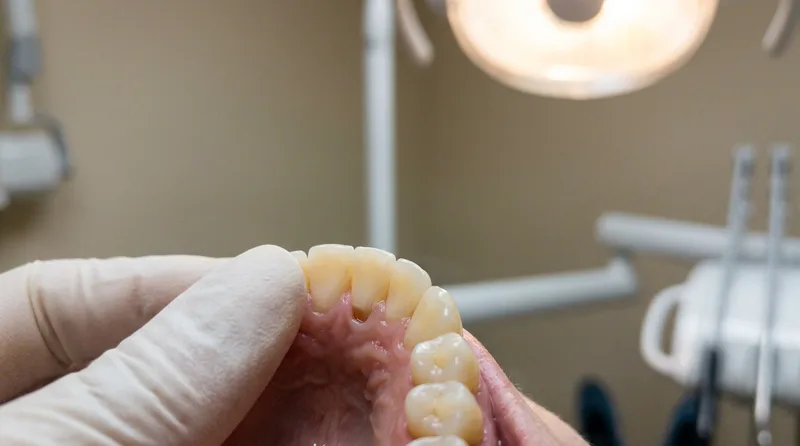
Abfraction is a wedge-shaped notch at the gumline caused by biomechanical stress rather than decay. It forms as off-axis forces concentrate at the cervical area where enamel is thinnest, causing enamel and dentin to fracture away in small increments over time.
Abfraction is a non-carious cervical lesion: a loss of tooth structure at the cervical area, the neck of the tooth near the gumline, that is not caused by decay. The word comes from the Latin for "breaking away," and the lesion appears as a wedge-shaped or scooped-out notch at the gumline that can range from barely visible to several millimeters deep.
The current leading theory for abfraction is that it is caused by biomechanical stress. When forces are applied to the tooth at angles other than directly down the long axis, the stress concentrates at the cervical region where the enamel is thinnest. Over time, repeated stress at this point causes the enamel and underlying dentin to fracture away in small increments, producing the characteristic notch shape. This theory explains why abfraction lesions are most common on the teeth that bear the most off-axis load: the premolars and canines, which sit at the corners of the arch and take significant lateral forces during chewing and grinding.
According to research published in the dental literature, abfraction lesions are found in an estimated 5% to 25% of adults depending on the population studied, according to that body of epidemiological evidence, with higher rates in patients who grind or clench their teeth.
Abfraction vs Erosion vs Abrasion: How to Tell Them Apart
Abfraction, erosion, and abrasion can all produce tooth loss at the gumline, and in many patients more than one process is happening simultaneously. Each has a characteristic appearance and mechanism that distinguishes it clinically, though the three often coexist and reinforce each other.
| Abfraction | Erosion | Abrasion | |
|---|---|---|---|
| Cause | Biomechanical stress / off-axis force | Acid dissolving enamel | Physical wear from brushing or objects |
| Shape | Wedge or V-shaped notch | Scooped, shallow, smooth | Groove or channel from friction |
| Location | Cervical gumline, usually labial surface | Broad surfaces, palatal on upper teeth | Where the brush contacts most |
| Surface texture | Hard, glassy | Smooth, rounded | Scratched or grooved |
| Typical teeth | Premolars, canines | Multiple teeth, especially upper back | Teeth brushed most aggressively |
| Associated with | Bruxism, malocclusion, parafunction | GERD, dietary acid, bulimia | Toothpick use, hard bristle brushing |
In practice, the three types of cervical lesions are often mixed. A patient with bruxism who also has acid reflux and brushes aggressively with a hard-bristled brush may develop lesions that have features of all three mechanisms simultaneously. Treatment addresses whichever contributing factors are present rather than treating only one cause.
What Causes Abfraction Lesions?
The primary cause of abfraction is parafunctional force, most commonly bruxism and clenching. When lateral forces concentrate at the cervical region repeatedly, enamel fractures away in small increments. Acid softening and aggressive brushing accelerate the process.
The primary cause of abfraction is parafunctional force, most commonly bruxism. According to the American Dental Association, non-carious cervical lesions including abfraction are a recognized and increasingly studied category of tooth loss distinct from decay. When a patient grinds or clenches their teeth, the lateral and off-axis forces are significantly amplified compared to normal chewing, and the concentration of stress at the cervical region exceeds what the tooth structure can sustain repeatedly over years.
Malocclusion, meaning a bite that does not distribute forces evenly across the dental arch, can also create the kind of uneven stress distribution that leads to cervical lesions. A single tooth that is slightly higher than its neighbors and therefore takes disproportionate impact with each bite cycles through more stress than properly aligned teeth. Over years, this produces characteristic notching on the overloaded tooth.
Acid exposure and aggressive brushing, while technically causing erosion and abrasion rather than abfraction, frequently coexist with abfraction and accelerate lesion development. Acid softens the cervical enamel, making it more susceptible to fracture under mechanical stress. Hard-bristled brushing at the gumline adds a physical abrasive component on top of the biomechanical one. This is why most clinically significant cervical lesions have contributions from more than one mechanism. Our article on bruxism and teeth grinding covers the full clinical picture of parafunctional habits and their consequences across the dentition.
Are Abfraction Lesions Dangerous?
Abfraction lesions are not dangerous acutely, but they are progressive. A shallow notch may cause only mild sensitivity. As it deepens, sensitivity increases and progressive removal of tooth structure at the cervical area can eventually compromise the structural integrity of the tooth.
Abfraction lesions are not dangerous in the acute sense, but they are progressive and can become structurally significant if left untreated over years. At a superficial stage, the notch may cause only cosmetic concern and mild temperature sensitivity. As it deepens, the progressive removal of tooth structure at the cervical area weakens the tooth and the sensitivity typically increases. Deep lesions can eventually compromise the structural integrity of the tooth and in extreme cases create a fracture risk.
The sensitivity associated with abfraction comes from the same mechanism as other forms of cervical hypersensitivity: the exposed dentin at the lesion has open tubules that respond to thermal, osmotic, and tactile stimuli. According to Healthline, abfraction lesions are among the recognized causes of tooth sensitivity at the gumline and can produce significant discomfort with temperature changes, sweet foods, and direct touch even when the lesion is relatively shallow.
How Is an Abfraction Lesion Treated?
Treatment has two components: addressing the contributing causes to stop further loss, and restoring the lost tooth structure if the lesion is symptomatic or structurally significant. Restoring without addressing the cause is not an adequate long-term solution.
Treatment for abfraction lesions has two components: addressing the contributing causes to stop further loss, and restoring the lost tooth structure if the lesion is symptomatic or structurally significant. The restoration without addressing the cause is not an adequate long-term solution, because the same forces that created the lesion will work on the restoration just as they worked on the tooth.
Addressing contributing causes typically involves:
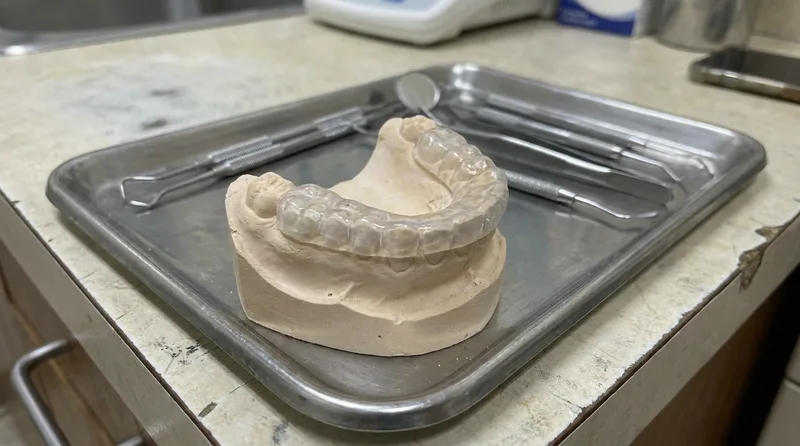
- Night guard for bruxism: A custom-fitted occlusal splint worn during sleep reduces the lateral forces that concentrate stress at the cervical region. For patients with significant abfraction driven by grinding, a night guard is often the most important intervention and should be placed before any restorative work.
- Bite adjustment: If a malocclusion or a single high tooth is contributing to the uneven force distribution, minor occlusal equilibration can redistribute the load more evenly across the arch.
- Brushing technique review: Switching to a soft-bristled brush and using a gentle scrubbing rather than horizontal scrubbing motion reduces the abrasive component at the cervical area.
- Acid management: Reducing dietary acid exposure and managing GERD or reflux reduces the acid softening that makes cervical enamel more susceptible to mechanical fracture.
Restoration of the lesion itself is typically done with composite bonding. The composite is applied to fill the notch, restoring normal contour and sealing the exposed dentin. Composite bonding for cervical lesions is conservative, does not require anesthesia in most cases, and produces immediate relief of sensitivity when the exposed dentin surface is covered. Our article on enamel erosion covers the restorative options available once surface structure has been lost, including bonding and other protective approaches.
When Should You See a Dentist About a Notch at the Gumline?
Any notch or indentation at the gumline is worth mentioning at your next dental visit. It indicates a process that will continue unless contributing factors are identified and addressed. A dentist can determine whether it is abfraction, erosion, abrasion, or a combination, and recommend the right next step.
Any notch or indentation at the gumline that you have noticed, whether painful or not, is worth mentioning at your next dental visit. The notch itself is not an emergency, but its presence indicates a process that will continue unless the contributing factors are identified and addressed. A dentist can evaluate whether the lesion is abfraction, erosion, abrasion, or a combination, assess the depth and rate of progression, and recommend whether monitoring, a night guard, or restorative treatment is the right next step.
Specific reasons to call sooner rather than later include sensitivity that is worsening, a notch that appears to be growing or deepening over months, pain when biting near the affected tooth, or any lesion that has become deep enough to be easily visible from a normal conversational distance. Our article on teeth sensitive to sweets covers how cervical exposure from abfraction, erosion, and gum recession all converge on the same symptom of sweet sensitivity, and our article on gum recession addresses the gum tissue changes that often accompany cervical lesions.
Noticed a notch at your gumline?
Book an evaluation at Willow Family Dentistry in Wylie, TX. Dr. Jeong will identify the cause, assess the depth and progression, and give you a clear plan to stop further loss and restore what has already been lost.
Explore preventive dentistryFurther Reading
Abfraction connects to several other conditions that affect tooth structure and surface integrity.
- Sudden Tooth Sensitivity to Cold: 8 Causes and Fixes
- Acid Reflux and Your Teeth: The GERD-Dental Connection
- Tartar vs Plaque: The Difference and Why It Matters
Results may vary. Please consult with Dr. Jeong for personalized treatment recommendations.
Dr. Esther B. Jeong, DDS
DDS · Willow Family Dentistry
Wylie family dentist with 15+ years of experience providing gentle, judgment-free dental care.
Frequently Asked Questions
Was this article helpful?



Have a dental question?
Schedule a consultation and get personalized answers from Dr. Jeong.
Call us
(972) 881-0715
Hours
Mon – Thu: 9am – 5pm
Fri: By Appointment
Location
1125 W FM 544, Wylie
Emergency? Same-day appointments available.