Adult Braces Options in Wylie, TX: You're Never Too Old

You're 35, maybe 50, and you've been thinking about it for years. Your teeth shifted after you stopped wearing that retainer in college, or maybe you never had orthodontic treatment at all. Here's what surprises most adults in Wylie, TX: there's no age limit on straightening your teeth. None.
About one in four orthodontic patients today is an adult, according to the American Dental Association. That number keeps climbing. And the adult braces options available now look nothing like what you remember from middle school. At Willow Family Dentistry, we see patients in their 40s, 50s, and beyond who finally decide it's their turn. They're right.
This article covers what's available, what to expect, and how to pick the right path for your smile and your schedule.
Are You Really Too Old for Braces?
No, you're not too old. Healthy teeth can be moved at any age because the biological process of bone remodeling doesn't stop when you turn 30. If your gums and jawbone are in reasonable shape, orthodontic treatment is a real option for you.
The misconception comes from a time when braces were almost exclusively a teenage rite of passage. That era is over. Modern orthodontics relies on the same principle at every age: gentle, sustained pressure shifts teeth through bone remodeling. Your bone cells respond to that pressure whether you're 16 or 62.
What does change with age? Treatment might take slightly longer for adults because bone density increases over time. Some adults also have existing dental work, like crowns or bridges, that requires a customized approach. But these are planning details, not deal-breakers.
Dr. Esther Jeong evaluates every adult patient individually, using iCAT 3D imaging to assess bone structure, root health, and alignment before recommending a treatment path. That level of diagnostic precision matters more for adults than for teens, because adult mouths have more history to account for.
What Adult Braces Options Work Best for Grown-Ups?
The best adult braces options depend on the complexity of your case, your lifestyle, and your budget. Clear aligners work for most mild-to-moderate alignment issues, while traditional or ceramic brackets handle more complex movements that aligners can't achieve alone.
Clear Aligners
This is what most adults ask about first. Removable, nearly invisible trays that gradually shift your teeth over 6 to 18 months. The American Association of Orthodontists reports that average clear aligner treatment takes 6-18 months compared to 18-36 months for traditional braces. Clear aligners can treat 90% of mild-to-moderate alignment issues, according to the American Journal of Orthodontics. You remove them to eat, brush, and floss. Big advantage for adults who don't want visible hardware at work or social events.
The catch? Compliance. You need to wear them 20-22 hours per day. Skip that, and your timeline stretches. Families near Wylie High School and throughout Murphy and Sachse have found this approach fits well into busy adult lives, though.
Ceramic Brackets
These use tooth-colored or clear brackets instead of metal. They're fixed, so compliance isn't a concern. They handle more complex cases than aligners but are less visible than traditional metal. Worth considering if your alignment issues are moderate to severe.
Traditional Metal Brackets
Still the most versatile option for complex orthodontic cases. Today's brackets are smaller and more comfortable than what you remember. For significant crowding, bite issues, or rotations, metal brackets remain the most efficient tool.
| Feature | Clear Aligners | Ceramic Brackets | Metal Brackets |
|---|---|---|---|
| Visibility | Nearly invisible | Low visibility | Most visible |
| Treatment Time | 6-18 months | 12-30 months | 12-36 months |
| Removable | Yes | No | No |
| Best For | Mild to moderate cases | Moderate to complex | All case types |
Thinking About Clear Aligners?
Our team can help you decide if clear aligners are the right fit for your smile goals and lifestyle.
Explore Clear Aligners →How Do Clear Aligners Compare to Traditional Braces for Adults?
Clear aligners offer shorter average treatment times and easier oral hygiene for adults with mild-to-moderate misalignment. Traditional braces provide more precise control for complex cases involving significant bite correction, rotations, or vertical tooth movements that aligners can't address as effectively.
Here's the thing most adults don't realize: the "best" option isn't always the most invisible one. A patient with a deep overbite and crowded lower arch might spend 24 months in aligners and get a mediocre result, or 18 months in ceramic brackets and get an excellent one. The treatment has to match the problem.
The ADA notes that straight teeth are easier to clean, reducing the risk of cavities and gum disease by up to 30%. That benefit applies regardless of which method gets you there. So the real question isn't "which looks better during treatment?" It's "which delivers the best long-term result for my specific situation?"
Adults in Allen, Plano, and the greater Wylie area often start with a preference for aligners. That's completely reasonable. But a thorough evaluation sometimes reveals that a different approach would be faster, more predictable, or both. A good provider will tell you that honestly.
Related: Wondering how orthodontics fits into a broader smile transformation? → Smile Makeover Cost: Process and Results in Wylie TX
What Should Adults Expect During Orthodontic Treatment?
Expect an initial consultation with imaging and a custom treatment plan, followed by regular progress appointments every 4-8 weeks. Most adult treatments take 6-24 months depending on complexity, and you'll wear a retainer afterward to protect your results long-term.
The first step at Willow Family Dentistry is a comprehensive exam. Dr. Jeong uses our iCAT 3D imaging system to capture a full picture of your teeth, roots, and jawbone. That's not standard at every practice. Three-dimensional imaging catches issues that traditional X-rays miss, like root resorption or hidden bone loss, both of which affect treatment planning for adults.
Before You Start
Any existing dental issues need to be handled first. Cavities, active gum disease, or failing restorations should be treated before orthodontic work begins. The CDC reports that 42% of adults aged 30 and older have some form of periodontal disease. If that includes you, it doesn't disqualify you from braces. It just means we address the gum health first.
During Treatment
You'll visit the office every 4-8 weeks for adjustments or new aligner trays. Mild soreness after adjustments is normal and typically fades within a few days. Most adults report that the discomfort is far less than they expected. Really.
Oral hygiene takes a bit more effort with fixed brackets. With aligners, you simply remove them and brush normally. Either way, regular preventive care appointments continue throughout treatment.
After Treatment
Retainers are non-negotiable. Your teeth will try to shift back, especially in the first year. Most adults wear a retainer nightly for life, or use a bonded wire behind the front teeth. Skipping the retainer is how people end up needing treatment twice. Don't be that person.
Nervous About Getting Started?
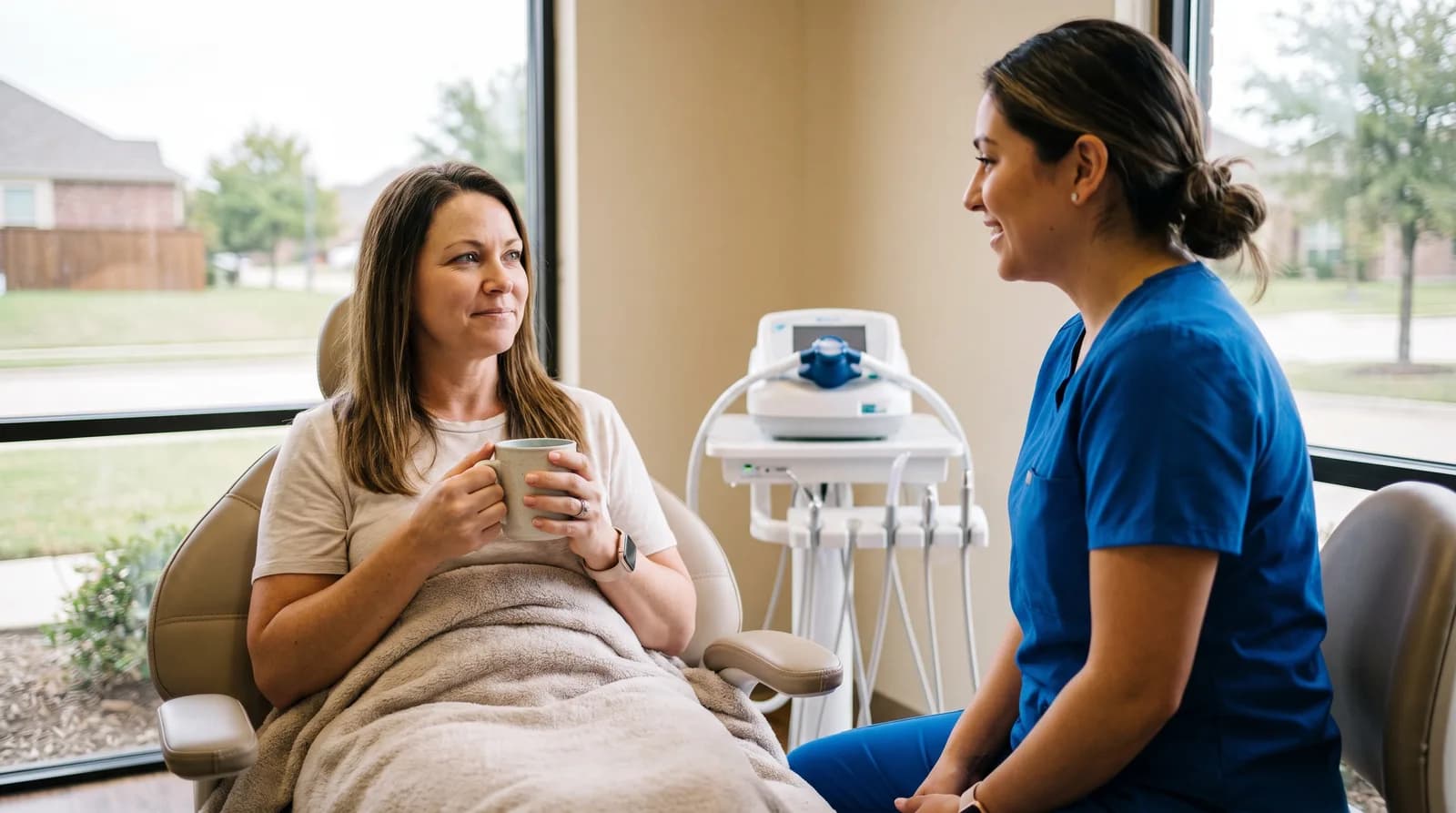
We offer nitrous oxide and IV sedation for patients who feel anxious about dental procedures. You don't have to white-knuckle it.
Learn About Sedation Options →Can Straighter Teeth Actually Improve Your Overall Health?
Yes, and the connection is stronger than most people think. Properly aligned teeth are significantly easier to brush and floss, which directly reduces your risk of cavities, gum disease, and the systemic health problems linked to chronic oral infections.
Crooked or crowded teeth create overlapping surfaces where plaque hides. Your toothbrush can't reach those spots effectively. Neither can floss. Over months and years, that trapped bacteria leads to decay and gum inflammation. The ADA has found that straight teeth reduce the risk of cavities and gum disease by up to 30%. That's not a cosmetic statistic. That's a health statistic.
There's also the bite factor. Misaligned teeth distribute chewing forces unevenly, which can wear down enamel on certain teeth faster than others. Some adults develop jaw tension, headaches, or TMJ discomfort from a bite that's been slightly off for decades. Orthodontic treatment can address the root cause rather than just managing symptoms.
And then there's the confidence piece. The American Academy of Cosmetic Dentistry found that 99.7% of Americans believe a smile is an important social asset. Wylie adults who've completed orthodontic treatment consistently tell us they smile more freely, speak up more in meetings, and feel better in photos. That's not vanity. That's quality of life.
- Reduced decay risk: Straight teeth are up to 30% easier to keep clean, according to the ADA
- Better gum health: Proper alignment eliminates hard-to-reach plaque traps between crowded teeth
- Less jaw stress: Corrected bites distribute chewing force evenly, reducing TMJ symptoms
- Improved confidence: Adults frequently report social and professional benefits after treatment
Does Dental Anxiety Stop Adults from Pursuing Braces?
Dental anxiety is one of the top reasons adults delay orthodontic treatment, but it shouldn't be. Modern sedation options and gentler techniques mean anxious patients can receive comfortable care without the stress they're imagining.
The numbers tell the story. According to a 2024 study published in BMC Oral Health, 36% of Americans experience dental anxiety, and 12% have extreme dental fear. That's a significant portion of the adult population avoiding care they need. Sedation dentistry has helped 75% of fearful patients maintain regular dental visits, according to the Journal of Dental Anesthesia.
At Willow Family Dentistry on W FM 544, Suite 700, we offer two sedation options: nitrous oxide for mild-to-moderate anxiety and IV sedation for more significant fear. Having both available matters because one size doesn't fit all when it comes to anxiety management.
Our multilingual team speaks English, Korean, Spanish, and Vietnamese. For some patients, anxiety drops considerably when they can communicate in their first language. Small detail. Big difference.
Dr. Jeong built this practice around a judgment-free philosophy. That means no lectures about why you waited so long, no pressure to choose the most expensive option, and no rushed appointments. Patients from Sachse, Lucas, McKinney, and across North Texas choose us specifically because of that approach.
Ready to Explore Your Adult Braces Options?
Schedule a consultation to find out which orthodontic approach fits your teeth, your timeline, and your life.
View Orthodontic Services →How Do You Choose the Right Orthodontic Provider in Wylie?
Look for a provider who offers multiple treatment types, uses advanced diagnostic imaging, and takes time to explain your options honestly. The right provider won't push the most expensive treatment or the quickest option. They'll recommend what actually works for your specific case.
Here's what to evaluate:
- Diagnostic technology: Does the practice use 3D imaging? Two-dimensional X-rays miss details that matter for adult treatment planning. iCAT cone beam imaging gives your provider a complete three-dimensional view of roots, bone, and airway
- Treatment range: A practice that only offers one type of orthodontic treatment will recommend that treatment regardless of whether it's ideal for you. Look for providers offering clear aligners, ceramic brackets, and traditional brackets
- Adult experience: Treating adults is different from treating teens. Ask how many adult patients the practice sees and what outcomes they've achieved
- Comprehensive care: Adults often need restorative work or cosmetic finishing alongside orthodontics. A practice that handles everything under one roof saves you time and coordination headaches
The ADA recommends that regular dental visits catch 80% of oral health issues before they become serious. That same principle applies to choosing an orthodontic provider: thorough initial evaluation prevents surprises mid-treatment. A private practice like Willow Family Dentistry, rather than a corporate chain, typically offers longer appointment times and more individualized attention. That's not marketing language. It's a structural reality of how private practices operate.
Your adult braces options deserve the same careful consideration you'd give any other health decision. Take the consultation. Ask hard questions. The right provider will welcome them.
The most important thing to know about adult orthodontics in Wylie is this: the only wrong time to start is never. Your teeth, your gums, and your confidence are all worth the investment, whether you're 30 or 70. And with today's adult braces options, treatment is more comfortable, more discreet, and more effective than anything available even a decade ago. The next step is simple: find out what's possible for your smile.
Your Straighter Smile Starts Here
Schedule your consultation at Willow Family Dentistry in Wylie, TX and discover which adult orthodontic option fits your life.
Request an Appointment →Have questions before booking? We're happy to help.
Contact Us →Dr. Esther B. Jeong, DDS
DDS · Willow Family Dentistry
Wylie family dentist with 15+ years of experience providing gentle, judgment-free dental care.
Frequently Asked Questions
Was this article helpful?
You may also like

Have a dental question?
Schedule a consultation and get personalized answers from Dr. Jeong.
Call us
(972) 881-0715
Hours
Mon – Thu: 9am – 5pm
Fri: By Appointment
Location
1125 W FM 544, Wylie
Emergency? Same-day appointments available.