Tooth Replacement Options for Elderly Patients (2026)
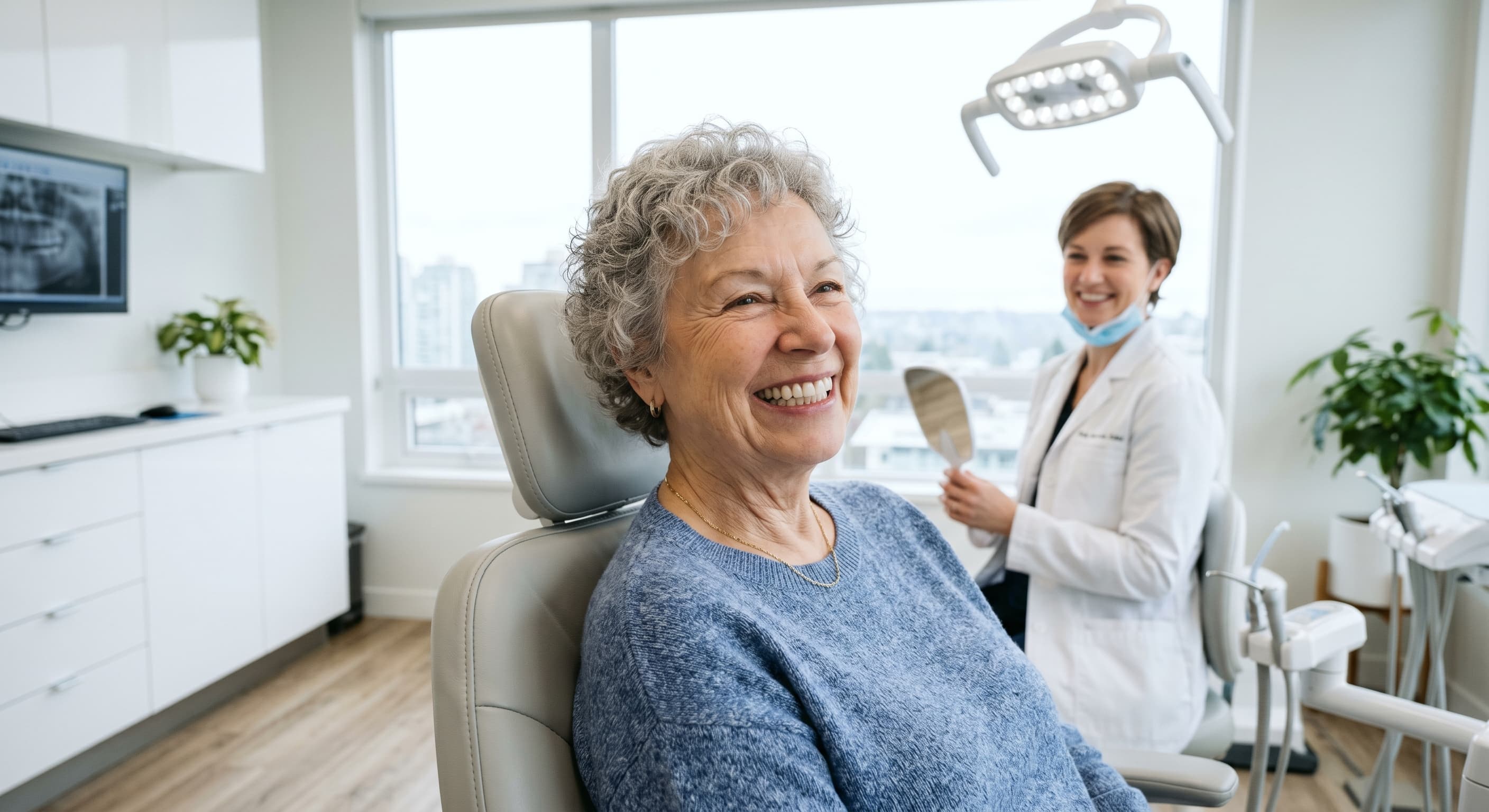
Choosing the right tooth replacement options for elderly patients involves a different calculation than at 35 or 45. The clinical options are the same (implants, bridges, dentures), but the decision-making factors shift: bone density may be reduced, medical conditions add complexity, medication interactions need consideration, healing takes longer, and the cost-benefit analysis changes when you're weighing treatment against a different time horizon.
These factors don't eliminate options. They reprioritize them. A 75-year-old in good health is a perfectly reasonable implant candidate. An 85-year-old on blood thinners with moderate osteoporosis may do better with a well-fitted denture. The right answer depends on the individual, not the age.
Dr. Esther Jeong at Willow Family Dentistry in Wylie, TX has the conversations about tooth replacement options for elderly patients regularly, often with the patient and their adult children together. Families from Wylie, Murphy, Sachse, Lucas, and Lavon bring an aging parent in for exactly this conversation. She uses iCAT 3D imaging to evaluate bone volume precisely, reviews the complete medical and medication history, and presents options honestly, including the option of doing less when less is appropriate. There's no rush. The right decision made thoughtfully outperforms the aggressive decision made prematurely.
Dr. Jeong compares all three options honestly at consultation rather than steering you to the most expensive. See dental implants in Wylie.
Age alone is never the disqualifier. The right answer depends on the individual, not the age.
What Are the Tooth Replacement Options?
| Option | Best For | Lifespan | Cost | Surgery? |
|---|---|---|---|---|
| Dental Implant | Patients with adequate bone, good health, wanting permanent solution | 20-30+ years (often lifetime) | Premium investment per tooth | Yes (minor oral surgery) |
| Implant-Supported Denture | Full arch replacement with stability, no slipping | 15-25 years (implants); denture relined every 5-7 years | Highest overall investment, per arch | Yes (4-6 implants per arch) |
| Fixed Bridge | 1-2 missing teeth with strong adjacent teeth | 10-15 years | Mid-range investment per unit | No (adjacent teeth are crowned) |
| Removable Partial Denture | Multiple missing teeth, wanting affordable non-surgical option | 5-7 years before reline/remake | Most budget-friendly option | No |
| Complete Denture | All teeth missing, budget-conscious or not a surgical candidate | 5-7 years before reline/remake | Budget-friendly to mid-range, per arch | No |
Are Dental Implants Safe for Seniors?
Yes. The Mayo Clinic reports implant success rates of 90-95% in older adults when patients are properly selected. Age alone is never the disqualifier. The factors that determine candidacy are specific and evaluable.
Bone Density and Volume
The implant needs enough bone for osseointegration, the process by which the titanium implant fuses directly to living bone tissue. The iCAT 3D scan at Willow measures bone height, width, and density in millimeters at the exact site where the implant would be placed. If bone is insufficient, bone grafting can build the site over 3-6 months before implant placement. Patients with osteoporosis often still have adequate jawbone for implants because jawbone density doesn't always mirror hip or spine density. According to clinical research, osteoporosis reduces but doesn't eliminate implant candidacy; the iCAT scan answers the question definitively for each patient.
Medical Clearance
Uncontrolled diabetes (A1C above 8.0), active cancer treatment, recent radiation to the jaw, and severe immunosuppression are conditions where implant surgery may need to be delayed until the condition is better controlled. Controlled diabetes, stable heart disease, managed hypertension, and most chronic conditions are not contraindications. Dr. Jeong coordinates with the patient's physician for medical clearance when needed.
Medications
Blood thinners (warfarin, Eliquis, Xarelto) require coordination: some patients can safely undergo implant surgery without stopping their anticoagulant; others benefit from temporary modification under physician supervision. Bisphosphonates for osteoporosis require evaluation of duration and type (oral vs IV). According to the ADA, oral bisphosphonate use for less than 4 years carries less than 1% risk of osteonecrosis with implant surgery.
Healing Capacity
Older adults heal more slowly than younger ones, and Dr. Jeong builds longer healing intervals into the treatment timeline. Where a 35-year-old might wait 3 months between implant placement and crown delivery, a 75-year-old might wait 4-6 months. The outcome is the same; the timeline is adjusted.
Keep Reading
Full implant cost breakdown. → Dental Implant Cost in Wylie, TX: 2026 Line-Item Breakdown
Related: Want the full candidacy picture, not just the safety basics. See the full guide to dental implants for seniors →
Find Out If Implants Are Realistic in Your Case
The iCAT 3D scan measures your actual bone in millimeters, so candidacy stops being a guess. Dr. Jeong reviews your medications and medical history in the same visit.
Book an Implant Consultation →Or call (972) 881-0715
When Does a Bridge Make More Sense Than an Implant?
How a Bridge Works
A fixed bridge replaces a missing tooth by crowning the teeth on either side of the gap and suspending a false tooth (pontic) between them. No surgery. No bone grafting. No healing period beyond the standard crown preparation process. The bridge is cemented permanently and functions like natural teeth.
When Dr. Jeong Recommends One
Dr. Jeong recommends a bridge over an implant in several senior-specific scenarios:
- When the adjacent teeth already need crowns (they have large failing fillings or structural compromise), bridging them serves double duty: restoring the compromised teeth and replacing the missing one simultaneously.
- When the patient's medical status makes surgery inadvisable and the window for safe surgery is uncertain.
- When the bone at the implant site is severely deficient and the patient doesn't want to undergo the grafting process.
- When the patient simply prefers a non-surgical solution after weighing both options with full information.
The Trade-Off
Bridges require modifying (grinding down) the adjacent teeth to accept crowns, even if those teeth are healthy. This irreversible alteration is the primary drawback. Bridges also have a shorter lifespan (10-15 years) than implants (20-30+ years), meaning a 65-year-old may need the bridge replaced once, while a 75-year-old may not. According to the ADA, the decision between bridge and implant should consider the condition of adjacent teeth, the patient's surgical risk, and the expected longevity needed from the restoration.
What About Dentures?
Dentures remain a valid and sometimes optimal choice for seniors, particularly when multiple teeth are missing across the arch and individual implants for every missing tooth would be impractical or unaffordable. For patients facing full edentulism (the complete loss of natural teeth in an arch), dentures and implant-supported dentures are typically the two realistic paths forward.
Complete Dentures
Complete dentures replace all teeth in an arch. Modern complete dentures are more comfortable and natural-looking than the dentures of 30 years ago, but they still rest on the gum ridge without bone anchorage. This means they shift during eating and speaking, require adhesive for stability in many patients, and gradually lose fit as the jawbone resorbs beneath them. According to the ADA MouthHealthy, dentures should be professionally relined every 5-7 years to accommodate bone changes.
Implant-Supported Dentures
Implant-supported dentures, sometimes called All-on-4 style restorations, are the upgrade that transforms the denture experience. Four to six implants placed in the jawbone provide snap-in or screw-retained anchorage for the denture. The denture doesn't move. It doesn't require adhesive. It restores 85-90% of natural chewing efficiency (compared to 25-40% for conventional dentures). And the implants stimulate the jawbone, slowing the resorption that makes conventional dentures progressively looser.
Chewing Efficiency Restored
- Implant-supported denture: 85-90% of natural chewing efficiency
- Conventional denture: 25-40%
Dr. Jeong considers implant-supported dentures the single highest-impact treatment she offers for patients who've struggled with loose conventional dentures. According to patient satisfaction research, implant-supported dentures consistently rank among the highest-satisfaction dental treatments, with quality-of-life improvements that patients describe as transformative.
Removable Partial Dentures
Removable partial dentures replace some teeth while clasping to remaining natural teeth for support. They're the most affordable replacement option, require no surgery, and can be modified as the patient's dental situation changes (additional teeth can be added to the partial if more teeth are lost later). The compromises: clasps can be visible, the partial must be removed for cleaning, and fit degrades over time as supporting teeth and bone change.
Tired of a Denture That Slips?
Anchoring an existing-style denture on four to six implants is the change patients describe as transformative. Dr. Jeong will tell you honestly whether your bone can support it.
Book an Implant Consultation →Or call (972) 881-0715
How Should Seniors Decide?
Dr. Jeong walks patients through a decision framework that considers four factors in order of priority.
1. Health Status and Surgical Candidacy
If surgery is safe, all options are on the table. If surgery carries elevated risk, non-surgical options (bridges, dentures) move to the front. This isn't an age threshold. It's a medical assessment specific to you.
2. Bone Availability
The iCAT scan answers this definitively. Adequate bone means implants are possible. Insufficient bone means grafting first (adding time and cost) or choosing a non-surgical option. Some patients have excellent bone at 80. Some have inadequate bone at 60 from years of periodontal disease.
3. Functional Goals
A patient who wants to eat steak, corn on the cob, and apples needs stable, anchored teeth (implants or implant-supported dentures). A patient who eats soft foods and wants basic function may be well-served by a conventional denture or partial. Matching the treatment to the functional demand prevents both over-treatment and under-treatment.
4. Financial Reality
Dr. Jeong presents every option with transparent pricing and honest assessment of value at each price point. A premium-investment implant that lasts 20+ years may cost less per year than a budget-friendly denture that needs replacement every 5-7 years. But the upfront cost matters, and not every patient can or should finance a premium option. HSA/FSA funds, dental insurance, and in-office payment plans at Willow make higher-investment options accessible for patients who choose them. Original Medicare generally doesn't cover tooth replacement, though some Medicare Advantage plans include dental benefits worth checking before treatment is planned.
Keep Reading
Senior dental care fundamentals. → Dental Care for Seniors: Common Issues After 60
What About Doing Nothing?
When Replacement Isn't Necessary
This is a legitimate discussion point that Dr. Jeong raises when appropriate. Not every missing tooth needs replacement. A missing molar at the very back of the arch with no opposing tooth and no functional consequence may not warrant the cost and effort of replacement. A patient with terminal illness or severe cognitive decline may benefit more from comfort-focused care than from complex restorative treatment.
The Consequences Depend on Location and Number
- A single missing back tooth with no opposing tooth: minimal consequences.
- A missing front tooth: aesthetic and social impact.
- Multiple missing teeth: bite collapse, shifting of remaining teeth, reduced chewing efficiency, nutritional decline, and accelerated bone loss that makes future replacement harder.
According to the ADA, the most common consequence of not replacing missing teeth in seniors is nutritional decline from reduced chewing ability, which compounds other age-related health risks.
The Decision Belongs to the Patient
Dr. Jeong's role is to present the options, explain the trade-offs of each including doing nothing, and support the patient's informed decision without pressure. Some patients choose implants at 82 and are thrilled. Some choose dentures at 65 and are satisfied. Some choose to leave a gap and live well with the trade-off. The best decision is the one made with complete information and without rush.
The Bottom Line
Tooth replacement, a core part of geriatric dentistry, spans from a budget-friendly denture to a premium implant-supported arch, and every option between has a legitimate place depending on health, bone, goals, and budget. Age narrows nothing automatically. It adjusts timelines, requires medical coordination, and shifts the cost-benefit analysis in ways that deserve thoughtful conversation rather than blanket recommendations.
If you or a parent are considering tooth replacement, schedule a consultation at Willow Family Dentistry. Dr. Jeong will evaluate the specific situation with 3D imaging, present every option with pricing, and support whichever decision makes sense for the person, not just the teeth.
Results may vary. Please consult with Dr. Jeong for personalized treatment recommendations.
Every Option. Honest Assessment. No Pressure.
Dr. Jeong presents implants, bridges, dentures, and doing nothing with transparent pricing and a candid prognosis. Family members are welcome at the consultation.
Book an Implant Consultation →Or call (972) 881-0715 · 1125 W FM 544, Suite 700, Wylie, TX 75098
Dr. Esther B. Jeong, DDS
DDS · Willow Family Dentistry
Wylie family dentist with 15+ years of experience providing gentle, judgment-free dental care.
Frequently Asked Questions
Was this article helpful?

Have a dental question?
Schedule a consultation and get personalized answers from Dr. Jeong.
Call us
(972) 881-0715
Hours
Mon – Thu: 9am – 5pm
Fri: By Appointment
Location
1125 W FM 544, Wylie
Emergency? Same-day appointments available.