Oral Cancer Screening Wylie TX: A 5-Minute Lifesaver
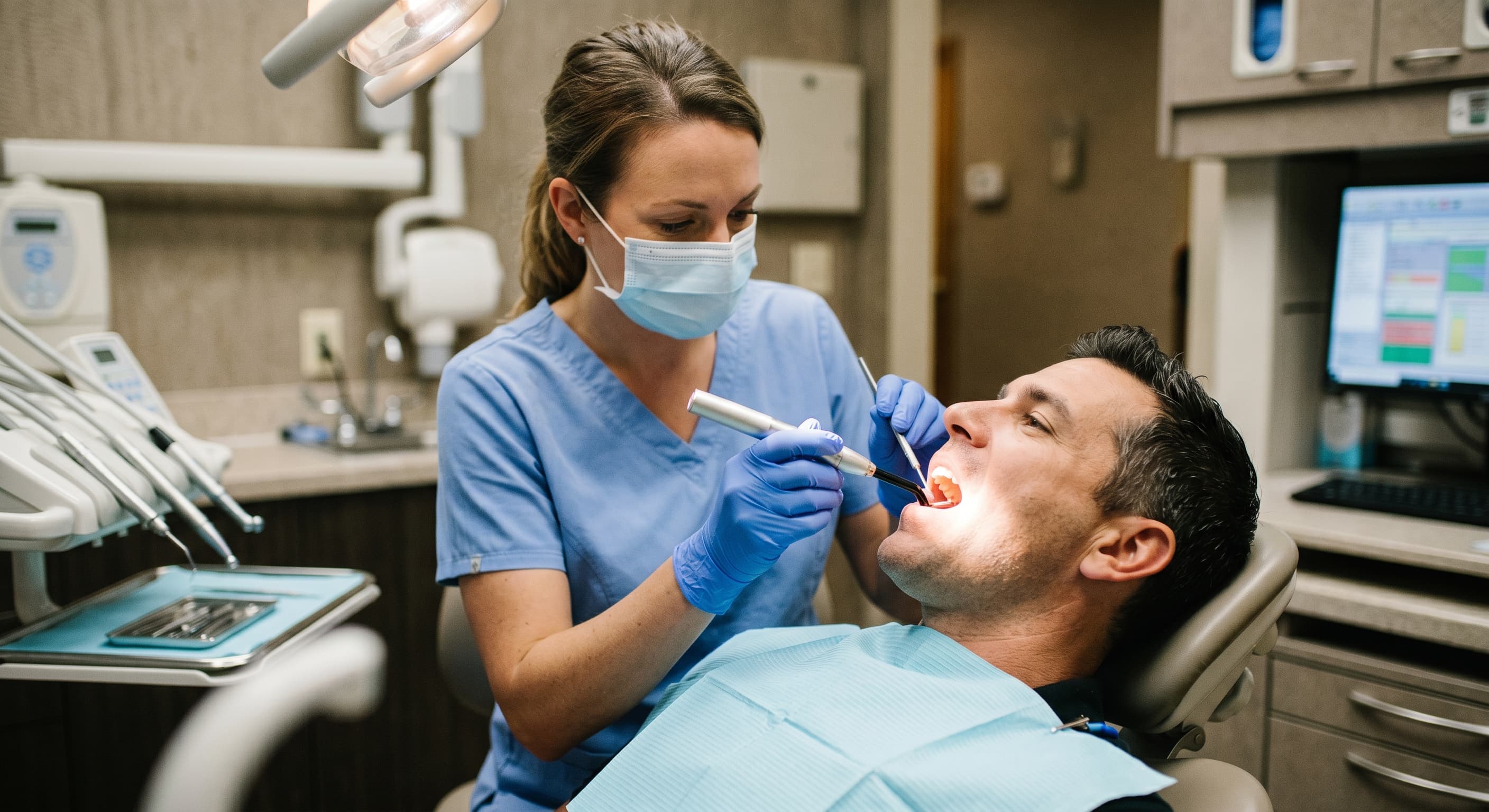
An oral cancer screening in Wylie, TX takes less than 5 minutes and is already part of your routine dental exam at Willow Family Dentistry. Most patients don't realize it's happening because Dr. Esther Jeong integrates it seamlessly into every comprehensive exam and hygiene visit. There's no special appointment, no extra charge, and no discomfort. She checks your tongue, floor of mouth, palate, cheeks, lips, throat, and neck in a systematic visual and tactile examination that takes 3-5 minutes. That brief screening is the difference between catching oral cancer at Stage I (when the 5-year survival rate exceeds 80-90%) and catching it at Stage III or IV (when survival drops below 40%).
The American Cancer Society estimates that roughly 58,000 Americans will be diagnosed with oral or oropharyngeal cancer in 2026, and approximately 12,000 will die from it. The mortality rate isn't high because the cancer is untreatable. It's high because it's found late. Oral cancer doesn't hurt in the early stages. It doesn't look alarming to an untrained eye. And most patients don't examine their own mouths. The dentist who screens at every visit is often the only professional looking.
What Does Dr. Jeong Check During an Oral Cancer Screening?
The screening follows a systematic protocol that covers every tissue surface in the mouth and the surrounding structures. Dr. Jeong examines the same areas in the same order every time so nothing gets skipped.
Lips and commissures. She examines the outer lip surface, the inner mucosal surface (pulling each lip outward), and the corners of the mouth. Lip cancer, particularly on the lower lip, is associated with chronic sun exposure and is one of the most common oral cancers in outdoor workers in Texas. Early lip cancer often looks like a persistent sore or crusted patch that doesn't heal within 2-3 weeks.
Tongue. The lateral borders (sides) of the tongue are the highest-risk site for intraoral cancer. Dr. Jeong has you extend your tongue, moves it side to side with gauze, and examines the lateral, ventral (underside), and dorsal (top) surfaces under bright light. She's looking for white patches (leukoplakia), red patches (erythroplakia), non-healing ulcers, lumps, or areas of induration (hardening) that feel different from surrounding tissue.
Floor of mouth. The tissue beneath the tongue is the second most common site for oral cancer. Dr. Jeong palpates (presses) this area with a gloved finger, feeling for lumps, thickening, or tenderness that the patient hasn't noticed. Many early floor-of-mouth cancers are found by palpation rather than visual inspection because they develop beneath the mucosa.
Palate. Both the hard palate (front, bony) and soft palate (back, flexible) are examined visually for color changes, masses, or asymmetry. Palatal cancers are less common but can arise from minor salivary glands that are concentrated in this region.
Buccal mucosa and gums. The inner cheek lining and the gum tissue are checked for white, red, or mixed-color patches, ulcerations that haven't healed, and any new growths. According to the ADA, persistent mucosal changes lasting more than 2-3 weeks warrant biopsy regardless of the patient's risk profile.
Oropharynx. Dr. Jeong examines the tonsils, base of tongue, and back of the throat with a mirror. HPV-related oropharyngeal cancer has surged in recent decades and now accounts for the majority of new oropharyngeal diagnoses in the US, particularly in adults ages 40-60. The Mayo Clinic notes that HPV-positive oropharyngeal cancer often presents as a painless lump in the throat or a persistent sore throat that doesn't respond to antibiotics.
Neck and lymph nodes. Dr. Jeong palpates the submandibular (under the jaw), cervical (side of neck), and supraclavicular (above the collarbone) lymph nodes. Enlarged, firm, or fixed lymph nodes can indicate cancer that has spread from an oral primary site. This 30-second neck palpation catches metastatic disease that the intraoral exam alone would miss.
Screening Happens at Every Visit
Dr. Jeong performs oral cancer screening as part of every comprehensive exam and hygiene appointment. No extra charge. No special appointment. If you're overdue for a cleaning, you're overdue for a screening.
Request an Appointment →Who Is at Highest Risk for Oral Cancer?
Oral cancer can affect anyone, but certain risk factors dramatically increase the likelihood. Understanding your risk profile helps you take the screening seriously even when you feel fine.
Tobacco use is the strongest traditional risk factor. Smokers develop oral cancer at 5-10 times the rate of non-smokers. Smokeless tobacco (chewing tobacco, snuff, dip) concentrates carcinogens directly against the oral mucosa for extended periods, creating particularly high risk at the site of habitual placement. Former smokers remain at elevated risk for 10-15 years after quitting, though the risk decreases progressively. According to the CDC, tobacco in any form is implicated in approximately 75% of oral cancers in the US.
HPV (Human Papillomavirus) infection, specifically HPV-16, is now the leading cause of oropharyngeal cancer and a rising cause of oral cancer in non-smokers. HPV-related oral cancers typically affect adults ages 40-60, skew male, and often present at the base of the tongue or tonsils rather than the traditional oral cavity sites. The CDC estimates that HPV causes approximately 70% of oropharyngeal cancers in the US. HPV vaccination (Gardasil 9), recommended through age 26 and approved through age 45, prevents the HPV strains responsible for these cancers.
Alcohol use multiplies the risk from tobacco. A person who both smokes and drinks heavily has a 30-fold increased risk compared to someone who does neither. Alcohol acts as a solvent that increases mucosal permeability, allowing tobacco carcinogens to penetrate tissue more effectively. Heavy alcohol use alone (without tobacco) still carries 2-3 times the oral cancer risk of non-drinkers.
Sun exposure affects the lips specifically. Chronic UV exposure on the lower lip causes actinic cheilitis (a precancerous condition) that can progress to squamous cell carcinoma. Outdoor workers, ranchers, and anyone with significant cumulative sun exposure in Texas should have their lips examined carefully. Lip balm with SPF 30+ and wide-brimmed hats reduce risk.
Age. Over 90% of oral cancers occur in patients over 40, with the median diagnosis age around 62. However, the rise in HPV-related cancers has lowered the average age of oropharyngeal cancer diagnoses significantly over the past two decades.
Previous oral cancer diagnosis. Patients who have had one oral cancer have a 20-fold increased risk of developing a second primary cancer in the oral cavity or adjacent regions. Lifelong surveillance with oral cancer screening at every dental visit is essential for survivors.
What Are the Warning Signs Between Dental Visits?
Dr. Jeong screens at every visit, but 6 months can pass between cleanings. Knowing what to watch for between appointments allows you to seek evaluation sooner if something concerning appears.
Any sore in the mouth that doesn't heal within 2-3 weeks. Canker sores and bite injuries heal in 7-14 days. A sore that persists beyond 3 weeks without improvement warrants evaluation regardless of how minor it looks. Persistent, painless ulcers are the most common early presentation of oral cancer according to the ADA.
A white or red patch on the gums, tongue, tonsils, or mouth lining. White patches (leukoplakia) and especially red patches (erythroplakia) are considered precancerous. Not all white patches are cancer, but all persistent red patches should be biopsied.
A lump, thickening, or rough spot on the lip or inside the mouth. Run your tongue around the inside of your mouth monthly. If you feel something new, a bump, a ridge, a rough area that wasn't there before, schedule an evaluation.
Difficulty chewing, swallowing, or moving the tongue or jaw. Oral cancer can restrict the mobility of these structures as it grows. If chewing or swallowing becomes difficult without an obvious cause (like a sore throat from a cold), the mechanism needs investigation.
Numbness in the tongue or other oral areas. Loss of sensation where you previously had normal feeling is a neurological sign that something is pressing on or infiltrating a nerve. This is never normal and requires prompt evaluation.
A persistent sore throat, hoarseness, or the feeling that something is caught in your throat. These are common symptoms of oropharyngeal cancer, particularly HPV-related cancers at the base of the tongue or tonsils.
A lump in the neck. Painless, firm, progressively enlarging lymph nodes in the neck can be the first noticeable sign of oral or oropharyngeal cancer that has spread. According to clinical data, approximately 25% of oropharyngeal cancers are first detected as a neck mass before the primary tumor is identified.
What Happens If Dr. Jeong Finds Something Suspicious?
Finding something during screening doesn't mean it's cancer. The majority of oral lesions are benign: aphthous ulcers, irritation fibromas, mucoceles, and inflammatory conditions that look concerning but are clinically harmless. Dr. Jeong differentiates based on the lesion's appearance, location, duration, and clinical characteristics.
If a lesion has features suggestive of malignancy or premalignancy (persistent for 3+ weeks, hard or indurated borders, mixed white-and-red coloring, fixed rather than mobile, associated with lymphadenopathy), she refers to an oral surgeon or ENT specialist for biopsy. Biopsy is the only definitive way to diagnose oral cancer. The tissue sample is examined by a pathologist who determines whether the cells are benign, premalignant (dysplasia), or malignant (carcinoma).
If the lesion is likely benign but uncertain, she documents it with photographs and measurements and re-evaluates at a 2-3 week follow-up. A benign lesion will resolve or change in that window. A malignant or premalignant lesion won't. This watchful waiting approach avoids unnecessary biopsies while ensuring nothing concerning is dismissed.
The American Cancer Society emphasizes that early-stage oral cancer (Stage I) has a 5-year survival rate of 80-90%. Stage IV drops to 30-40%. The difference between those numbers is often a single dental visit where a screening caught what the patient hadn't noticed yet. The screening that happens in 5 minutes at your cleaning may be the most valuable 5 minutes in dentistry.
Related: Gum disease shares some risk factors with oral cancer. → Stages of Gum Disease: Gingivitis vs Periodontitis
An oral cancer screening in Wylie, TX is already included in your exam at Willow Family Dentistry. It costs nothing extra, takes 5 minutes, and catches a disease that kills 12,000 Americans per year primarily because it's found too late. If you're overdue for a dental visit, you're overdue for a screening. If you have risk factors (tobacco, heavy alcohol, HPV exposure, sun exposure, previous oral cancer), the screening is even more critical. Schedule your next cleaning and exam with Dr. Jeong. The 5 minutes she spends checking your mouth for cancer could be the most important part of the appointment.
5 Minutes. Every Visit. No Extra Charge.
Dr. Jeong performs oral cancer screening at every exam and hygiene visit. If you're overdue for a cleaning, you're overdue for a screening. Early detection saves lives.
Request an Appointment →Noticed a sore that won't heal?
Call (972) 881-0715 →Dr. Esther B. Jeong, DDS
DDS · Willow Family Dentistry
Wylie family dentist with 15+ years of experience providing gentle, judgment-free dental care.
Frequently Asked Questions
Was this article helpful?


Have a dental question?
Schedule a consultation and get personalized answers from Dr. Jeong.
Call us
(972) 881-0715
Hours
Mon – Thu: 9am – 5pm
Fri: By Appointment
Location
1125 W FM 544, Wylie
Emergency? Same-day appointments available.