Nitrous Oxide vs IV Sedation: Which Is Right for You?
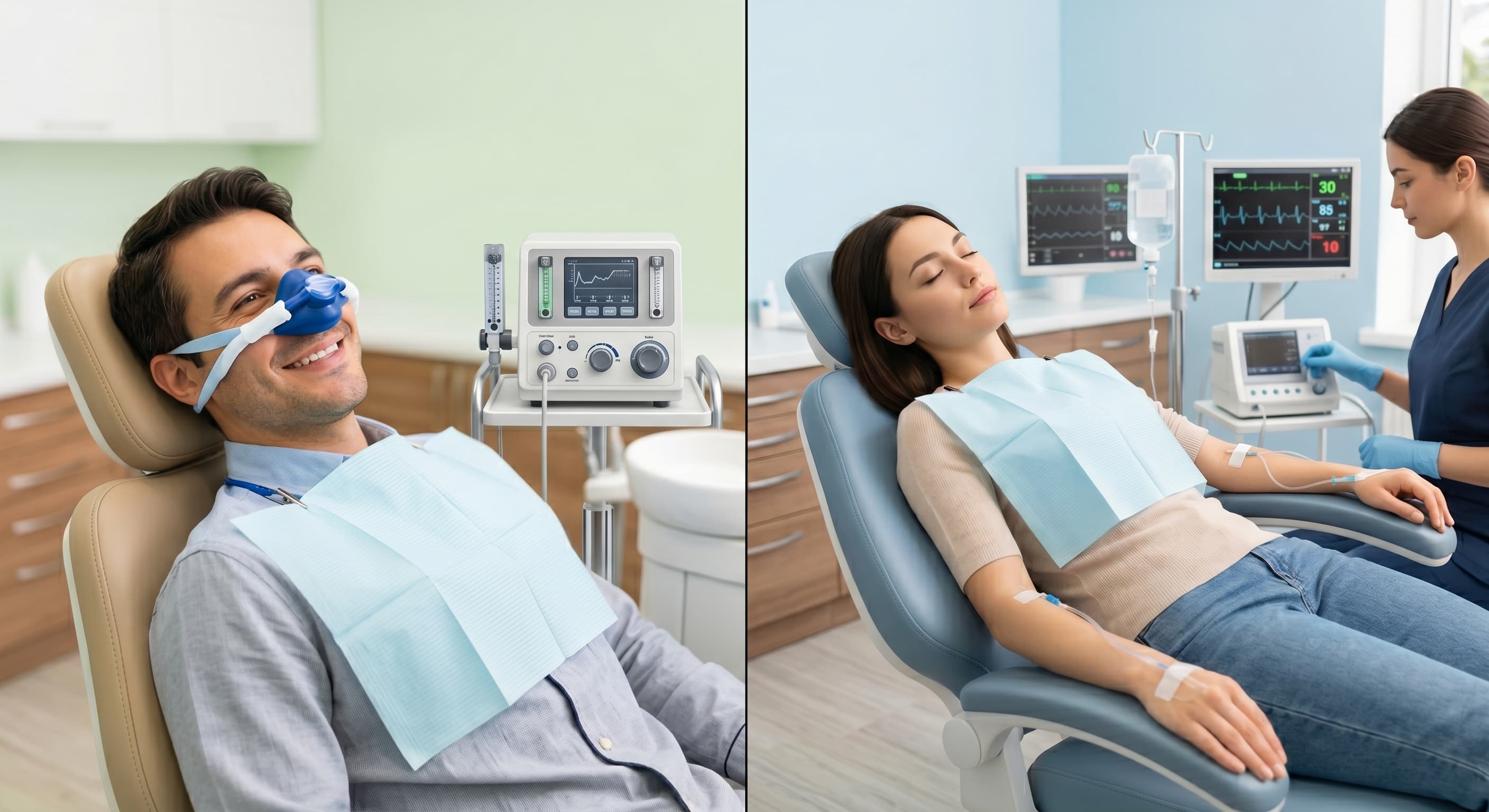
Choosing between nitrous oxide vs IV sedation isn't about finding the "best" option. It's about matching the sedation level to your anxiety, your procedure, and how the rest of your day needs to look. Both are safe, both are effective, and Willow Family Dentistry in Wylie, TX offers both so you're never forced into a one-size-fits-all approach. A 2024 study in BMC Oral Health found that 36% of Americans have dental anxiety and 12% have extreme fear. Those numbers represent a wide range of needs, and that's exactly why two sedation options exist.
This guide compares the two options Dr. Esther Jeong offers at Willow Family Dentistry, covering everything from how deep each one goes to what the recovery looks like, what they cost, and which procedures pair best with each.
Both options are available at our Wylie office. See sedation dentistry in Wylie.
What's the Difference Between Nitrous Oxide and IV Sedation?
Nitrous oxide is an inhaled gas that takes the edge off anxiety while keeping you fully conscious and aware. IV sedation delivers medication directly into your bloodstream, putting you in a twilight state where you're deeply relaxed and unlikely to remember the procedure. They sit on different points of the same spectrum, and neither one is general anesthesia.
Think of it this way. Nitrous oxide is like turning the volume down on your anxiety. You still hear everything, you still know where you are, and you can respond to every question. You just don't care as much. IV sedation is like changing the channel entirely. You're technically conscious, your protective reflexes work, you breathe on your own, but your brain isn't recording the experience. Most patients wake up and say, "Is it over already?"
The delivery method creates the core difference. Nitrous is breathed through a small nose mask that sits over your nostrils during the procedure. It takes effect within a few minutes and wears off within a few minutes after the mask is removed. IV sedation requires placing a small intravenous line, usually on the back of your hand, and the medication enters your bloodstream directly. The onset is faster (30-60 seconds), the effect is deeper, and it lingers for hours after the appointment.
Both options include local anesthetic for the actual dental work. Neither nitrous nor IV sedation replaces the numbing. They address the anxiety and awareness components. The local anesthetic handles the physical sensation.
How Deep Does Each Type of Sedation Go?
The depth of sedation determines what you'll experience, what you'll remember, and how your body responds during the procedure. Here's an honest comparison of nitrous oxide vs IV sedation on the metrics that matter most to patients.
| Metric | Nitrous Oxide | IV Sedation |
|---|---|---|
| Consciousness | Fully conscious and alert | Conscious but in twilight state |
| Awareness | Aware of surroundings, sounds, activity | Minimal awareness, dreamlike state |
| Memory | Full recall of the appointment | Little to no memory afterward |
| Anxiety Reduction | Mild to moderate relaxation | Deep relaxation, anxiety eliminated |
| Breathing | Normal, self-maintained | Self-maintained, monitored by pulse oximetry |
| Onset Time | 2-3 minutes | 30-60 seconds |
| Dosage Control | Adjustable in real time via gas flow | Adjustable in real time via IV drip |
A key distinction patients often miss: nitrous oxide reduces anxiety but doesn't eliminate awareness. If the sound of the dental handpiece bothers you, you'll still hear it. If seeing instruments overhead makes you tense, you'll still see them. Nitrous makes those triggers less distressing, but it doesn't make them disappear. IV sedation does. For patients whose anxiety is driven by sensory triggers or traumatic memories, that difference matters enormously.
Both options let Dr. Jeong adjust the dosage in real time. With nitrous, she changes the gas concentration. With IV sedation, she titrates the medication through the line. In both cases, she's watching your response and fine-tuning as needed. You're never locked into a fixed dose.
What Does Recovery Look Like for Each Option?
Recovery is where the two options diverge most sharply, and it's often the deciding factor for patients trying to choose between nitrous oxide vs IV sedation. The clinical effects may determine your comfort during the procedure, but recovery determines what the rest of your day looks like.
Nitrous Oxide Recovery
When Dr. Jeong turns off the nitrous and switches to pure oxygen, the gas clears your system in about five minutes. Not hours. Minutes. You'll feel completely normal by the time you stand up from the chair. You can drive yourself home. You can go back to work. You can pick up your kids from school. There are zero post-appointment restrictions.
This is the biggest practical advantage of nitrous. It fits into a busy schedule. A patient who has a 10 AM filling appointment can be back at their desk by 11:30 with no residual effects. For working parents, people with tight calendars, or anyone who doesn't want to lose a full day to a dental visit, nitrous is the obvious choice when the anxiety level allows it.
IV Sedation Recovery
According to the Mayo Clinic, IV sedation stays in your system much longer. You'll feel drowsy for 1-2 hours after the procedure, and the cognitive effects (foggy thinking, slower reaction time) can linger for the rest of the day. You need a responsible adult to drive you home. Don't drive, operate machinery, or make important decisions for 24 hours. Plan to rest, eat soft foods, and take it easy.
Most patients feel completely back to normal by the following morning. Some report sleeping unusually well the night after IV sedation, which makes sense considering the anti-anxiety medication is still working its way out. By day two, there's no trace of the sedation.
Not Sure Which Level You Need?
Dr. Jeong walks every patient through both options during a pre-procedure conversation. She'll recommend a level based on your anxiety, your procedure, and your preferences.
Request an Appointment →How Do the Costs Compare?
Nitrous oxide is the more affordable of the two by a wide margin, and it's sometimes included in the procedure fee at no additional charge. IV sedation runs considerably more per session, billed separately from the dental work itself. The price difference reflects the additional training, monitoring equipment, and medications required for IV sedation.
Here's the honest framing on value. If nitrous oxide manages your anxiety well enough to get through the appointment comfortably, it's the more economical choice by a wide margin. But if your anxiety is severe enough that nitrous doesn't cut it, spending more on IV sedation is a far better investment than cancelling the appointment and letting the dental problem get worse. An untreated cavity that becomes a root canal costs thousands more than the sedation fee would have.
Insurance Coverage
Dental insurance handles sedation coverage inconsistently. Some plans cover nitrous oxide as part of routine procedures, especially for pediatric patients. IV sedation coverage depends on whether the plan considers it medically necessary for the procedure being performed. Complex surgical procedures like implant placement or multiple extractions have a stronger case for coverage than a routine filling.
Our team at Willow Family Dentistry verifies your sedation benefits before the appointment so you know your out-of-pocket cost ahead of time. No surprises at checkout.
Related: Tips on getting the most from your dental plan. → Dental Insurance Wylie TX: How to Maximize Benefits
Which Procedures Work Best With Each Option?
The procedure itself often narrows the choice. Short appointments with minimal complexity pair well with nitrous. Long, involved appointments pair better with IV sedation. And the patient's anxiety level acts as a multiplier that can bump any procedure up to the next sedation level.
Best Fits for Nitrous Oxide
Routine cleanings and exams for patients with mild anxiety. Single-tooth fillings. A single crown preparation. Short procedures under an hour. Patients who need to drive themselves home or return to work. Pediatric patients who need a gentle calming effect. And anyone who wants anxiety relief without losing the rest of their day.
Best Fits for IV Sedation
Dental implant placement. Multiple extractions in one session. Full-quadrant restorative work (several crowns, fillings, and build-ups combined). Patients with severe dental phobia. Patients with a strong gag reflex that interferes with treatment. And patients who've avoided the dentist for years and need extensive catch-up work done efficiently.
Here's a practical decision shortcut: if you can imagine yourself sitting through the procedure with just a little help relaxing, nitrous is probably enough. If the thought of being aware during the procedure triggers real dread, IV sedation is the better path. Dr. Jeong helps patients make this call every day, and she'll give you a direct recommendation based on what she knows about your anxiety and your treatment plan.
Your Comfort Is the Priority
Whether you need nitrous oxide for a filling or IV sedation for implant surgery, Dr. Jeong tailors the approach to your anxiety level and your procedure.
Request an Appointment →Related: Want the full deep-dive on IV sedation specifically? → IV Sedation Dentistry: How It Works and Who It's For
How Does Dr. Jeong Help You Choose the Right Level?
The choice between nitrous oxide vs IV sedation isn't something you have to figure out alone. Dr. Jeong discusses it with you before every procedure where sedation might be appropriate, and the conversation is simpler than you'd expect.
She'll ask about your anxiety history. Have you had dental work before? What happened? Was the experience manageable, or did it leave a lasting impression? Are there specific triggers: the sounds, the needles, the feeling of being reclined? These details help her gauge where you fall on the anxiety spectrum and which sedation level matches.
She'll also factor in the procedure itself. A 20-minute filling for a patient with mild anxiety doesn't need IV sedation. A 90-minute implant placement for a patient who hasn't been to a dentist in eight years probably does. The treatment plan and the anxiety level work together to point toward the right choice.
Medical screening matters too. Dr. Jeong reviews your health history, medications, and any prior reactions to sedation or anesthesia. Certain conditions (uncontrolled hypertension, severe respiratory disease, pregnancy) may make IV sedation inadvisable, in which case nitrous oxide becomes the safer option. The ADA sets clear guidelines for patient screening, and Dr. Jeong follows every one of them.
And here's the part that matters most to anxious patients: there's no wrong answer. Some people start with nitrous, realize it's not quite enough, and opt for IV sedation at the next appointment. Others try IV sedation once and feel confident enough to go with nitrous for simpler procedures afterward. Your preference is valid at every stage, and Dr. Jeong's judgment-free philosophy means you'll never be made to feel like you should just "tough it out."
According to research published in the Journal of Dental Anesthesia and Pain Medicine, sedation dentistry has helped 75% of fearful patients maintain regular dental visits. That's the real measure of success: not just getting through one appointment, but building a pattern of care that keeps your teeth and gums healthy for the long run.
Related: More strategies for managing dental anxiety beyond sedation. → Dental Anxiety Tips: 7 Ways We Help Patients in Wylie, TX
The comparison between nitrous oxide vs IV sedation comes down to depth and logistics. Nitrous is lighter, clears instantly, and lets you drive home. IV sedation goes deeper, erases the memory, and requires a driver and a day off. Both are safe. Both work. The right one depends on how much help your anxiety actually needs and what your schedule allows.
If you've been avoiding dental care because you didn't know sedation was an option, or because you assumed it was all-or-nothing, now you know better. Willow Family Dentistry offers a spectrum. Dr. Jeong will help you find your spot on it.
Results may vary. Please consult with Dr. Jeong for personalized treatment recommendations.
Dental Care on Your Terms
Schedule a visit and tell us about your anxiety level. Dr. Jeong will recommend the sedation option that fits your comfort and your procedure.
Request an Appointment →Want to talk through your options first?
Call (972) 881-0715 →Dr. Esther B. Jeong, DDS
DDS · Willow Family Dentistry
Wylie family dentist with 15+ years of experience providing gentle, judgment-free dental care.
Frequently Asked Questions
Was this article helpful?



Have a dental question?
Schedule a consultation and get personalized answers from Dr. Jeong.
Call us
(972) 881-0715
Hours
Mon – Thu: 9am – 5pm
Fri: By Appointment
Location
1125 W FM 544, Wylie
Emergency? Same-day appointments available.