Child Knocked Out a Tooth: Baby vs Adult Tooth First Aid
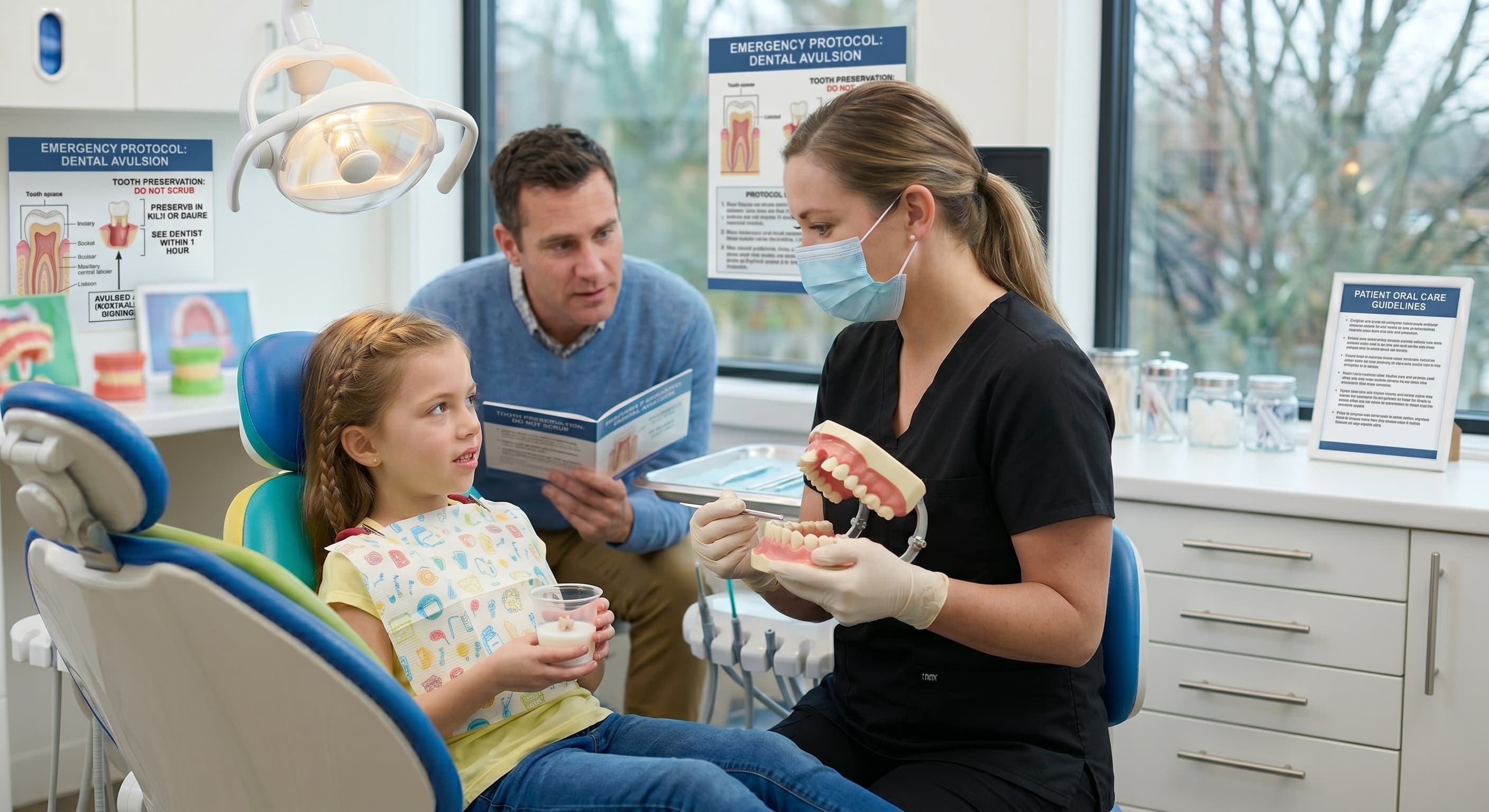
Your child knocked out a tooth and you have about 30 minutes to make the right call. The problem: the right call is completely different depending on whether the tooth is a baby tooth or a permanent (adult) tooth. Replanting a baby tooth can damage the developing permanent tooth underneath. Not replanting an adult tooth within 30 minutes can mean losing it permanently. These two scenarios require opposite responses, and most parents don't know which one they're dealing with in the moment. The American Academy of Pediatric Dentistry lists avulsed (knocked-out) teeth as one of the most time-critical dental emergencies in children. This guide gives you the step-by-step first aid for both scenarios so you know exactly what to do before you even reach the car.
Baby Tooth or Permanent Tooth: How to Tell the Difference
Before you do anything else, figure out which type of tooth came out. The first aid is completely different, and acting on the wrong protocol causes harm.
Your child's age is the strongest clue. Children lose their first baby teeth around age 6 and their last baby teeth around age 12. If your child is under 6, the knocked-out tooth is almost certainly a baby tooth. If your child is over 12, it's almost certainly permanent. Ages 6-12 are the gray zone where both types are present, and you need to look more carefully.
Baby teeth are smaller, whiter, and have shorter roots (or no visible root if the root was already resorbing in preparation for natural loss). The edges are smoother and more rounded. Permanent teeth are larger, slightly more yellow than baby teeth, have longer and more defined roots, and have visible ridges (mamelons) on the biting edge if they erupted recently. According to the ADA, correctly identifying the tooth type is the critical first step in avulsion management.
If you genuinely cannot tell, treat it as a permanent tooth (the more urgent scenario) and let the dentist determine the tooth type when you arrive. Erring toward more caution is always safer.
Baby Tooth Knocked Out: DO NOT Replant
This is the instruction that surprises most parents. If a baby tooth is knocked out, do not attempt to put it back in the socket. The AAPD and ADA both advise against replanting avulsed primary teeth because the replantation process can damage the permanent tooth bud developing directly beneath the socket. Pushing the baby tooth root back into the bone risks displacing, infecting, or fusing with the developing permanent tooth, creating a problem far worse than the missing baby tooth.
Here's what to do instead, step by step.
Stay calm and comfort the child. A knocked-out tooth bleeds, and the blood mixed with tears looks worse than it is. Apply gentle pressure to the socket with a clean gauze pad or damp washcloth. Have the child bite down gently on the gauze. The bleeding typically slows within 5-10 minutes.
Find the tooth and confirm it came out whole. If the tooth broke rather than avulsed cleanly, fragments may remain in the socket and need removal. Check the socket visually (gently) to see if tissue or bone looks displaced. If the socket area looks significantly swollen, deformed, or the adjacent teeth are shifted, there may be a jaw or alveolar bone fracture that requires urgent evaluation.
Apply a cold compress externally (ice pack wrapped in a cloth against the cheek, not directly on the gum) to reduce swelling. Give the child age-appropriate ibuprofen or acetaminophen for pain.
Call Dr. Jeong's office at (972) 881-0715 for a same-day evaluation. Even though the tooth isn't replanted, the dentist needs to check for socket damage, bone fracture, and soft tissue injury, and take an X-ray to verify the permanent tooth bud underneath is intact. According to the AAPD, follow-up imaging after baby tooth avulsion is standard of care to monitor the developing permanent tooth for signs of damage.
Keep the tooth for the tooth fairy. Seriously. Letting the child keep the tooth as a "trophy" normalizes the experience and reduces the emotional trauma. The tooth has no clinical use, but it has significant psychological value to a 5-year-old.
CRITICAL: Never Replant a Baby Tooth
Forcing a baby tooth back into the socket can damage the permanent tooth developing underneath. Control the bleeding, comfort the child, and call for a same-day evaluation.
Permanent Tooth Knocked Out: Replant Within 30 Minutes
A knocked-out permanent tooth is a genuine time-critical emergency. The periodontal ligament cells on the root surface begin dying within 15 minutes of being dry. If the tooth is replanted within 30 minutes with the ligament cells still viable, the success rate for the tooth reattaching to the bone (reimplantation survival) exceeds 85%. After 60 minutes outside the mouth, the success rate drops below 50%. After 2 hours dry, it drops to near zero. The Mayo Clinic and the International Association of Dental Traumatology both emphasize that time outside the socket is the single most important variable in avulsion outcomes.
Here is the step-by-step protocol. Read it now. Save this page. You won't have time to search for it when it happens.
Step 1: Find the tooth immediately. Pick it up by the crown (the white part). Never touch the root. The root is covered in periodontal ligament cells that are essential for reattachment. Touching, scrubbing, or wiping the root destroys these cells.
Step 2: If the tooth is dirty, rinse it gently. Hold the tooth by the crown and rinse the root briefly (10 seconds maximum) under clean running water or saline. Do not scrub. Do not use soap, alcohol, or hydrogen peroxide. Do not wrap it in tissue or paper towel (the fibers stick to the ligament and damage it). A brief water rinse removes visible dirt without destroying the cells you need alive.
Step 3: Replant the tooth yourself if possible. This is the step that scares parents, but it's the single most important action you can take. Hold the clean tooth by the crown, orient it correctly (the smooth side faces outward, the concave side faces the tongue), and gently push it into the socket with steady finger pressure. It doesn't need to be perfect. Getting it back in the socket and surrounded by blood supply is what matters. Have the child bite down gently on a gauze pad or damp cloth to hold it in position.
Step 4: If you cannot replant it, store it in milk. Whole milk (not skim, not water, not a dry napkin) is the best readily available storage medium. The pH and osmolality of milk closely match the conditions the periodontal ligament cells need to survive. Saliva (having the child hold the tooth between their cheek and gum) is the second-best option if milk isn't available. Saline (contact lens solution) is third. Water is a last resort. Dry storage (a pocket, a napkin, a plastic bag with no liquid) is the worst option because the cells desiccate rapidly. According to dental traumatology research, teeth stored in milk for up to 60 minutes maintain cell viability comparable to immediate replantation.
Step 5: Get to the dentist within 30 minutes. Call (972) 881-0715 on the way. Dr. Jeong sees dental trauma as a same-day emergency. If the tooth has been replanted, she'll stabilize it with a flexible splint (a thin wire bonded to the adjacent teeth that holds the replanted tooth in position while it reattaches over 2-4 weeks). If it hasn't been replanted, she'll replant it, verify the position with an X-ray, and splint it in place. The iCAT 3D scan may be used to evaluate the socket for fractures and confirm root integrity.
30-Minute Rule for Permanent Teeth
Pick up by the crown. Rinse briefly. Push it back in the socket. Bite on gauze. Call (972) 881-0715 on the way. Every minute in the socket improves the outcome.
Related: Helping fearful kids through dental emergencies. → My Child Is Afraid of the Dentist: 6 Tricks That Work
What Happens at the Emergency Dental Visit?
Dr. Jeong evaluates the situation with three priorities: save the tooth (if permanent), assess collateral damage, and plan follow-up monitoring.
For a replanted permanent tooth, she verifies the position with an X-ray, adjusts if needed, and bonds a flexible splint that holds the tooth stable for 2-4 weeks while the periodontal ligament reattaches. She prescribes antibiotics to prevent infection in the socket and a chlorhexidine rinse to keep the area clean while brushing is restricted. A follow-up visit at 2 weeks removes the splint. Additional follow-ups at 4 weeks, 3 months, 6 months, and 1 year monitor for root resorption (a complication where the body slowly breaks down the replanted root) and nerve vitality.
For an avulsed baby tooth, she X-rays the area to check for socket fracture and evaluates the developing permanent tooth bud underneath. If the socket is intact and the permanent tooth appears undamaged, no treatment beyond monitoring is needed. If bone displacement occurred, she may need to reposition the bone fragment and place a small splint. Follow-up imaging at 6 months and 1 year tracks the permanent tooth's development.
For associated injuries (lip lacerations, adjacent tooth fractures, jaw bruising), she addresses each one during the same visit. Dental avulsion rarely happens in isolation. The force that knocks out a tooth usually injures the surrounding soft tissue as well.
What Are the Long-Term Outcomes?
For baby teeth, the primary concern is whether the permanent tooth underneath was damaged. In most cases, it wasn't, and the permanent tooth erupts normally on schedule. In some cases (particularly when the avulsion was violent or the baby tooth root was driven into the bone), the permanent tooth may erupt with enamel defects, delayed eruption timing, or malalignment. These are correctable with dental treatment when the permanent tooth arrives.
For permanent teeth replanted within 30 minutes, long-term survival rates exceed 85%. The tooth functions normally, looks normal, and can last decades or a lifetime. The two complications to monitor for are root resorption (5-20% of cases, where the body gradually dissolves the replanted root over years) and pulp necrosis (the nerve dies, requiring root canal treatment in 30-50% of replanted teeth). According to the ADA, both complications are manageable when caught through regular follow-up imaging.
For permanent teeth replanted after 60+ minutes or stored dry, the prognosis is significantly worse. The tooth may survive initially but has a high probability of ankylosis (fusing directly to bone without a periodontal ligament buffer) or progressive root resorption leading to eventual loss. Even in these cases, replantation buys time: the tooth can function for years while the child grows, allowing a dental implant to be placed once jaw growth is complete (typically age 18+).
Related: When should a child's first dental visit happen? → When Should a Child First See a Dentist?
How to Prevent Knocked-Out Teeth in Kids
Contact sports and active play are the leading causes of avulsed teeth in children. Prevention is simpler and cheaper than treatment.
Custom mouthguards for sports are the single most effective prevention. A custom guard from Dr. Jeong absorbs and distributes impact force across all teeth rather than allowing it to concentrate on one. The ADA recommends mouthguards for any sport involving contact, collision, or falling risk: football, basketball, soccer, baseball, hockey, skateboarding, gymnastics, and martial arts. Boil-and-bite guards from the drugstore are better than nothing, but custom guards fit securely, allow normal breathing and speaking, and are worn more consistently because they're comfortable.
Helmets with face guards for high-impact sports (football, hockey, lacrosse) protect the entire lower face. Seatbelts and car seats for travel. Supervision around playgrounds and pools where falls and collisions are common. And the conversation: telling your child that if a tooth gets knocked out, they should find it, keep it wet, and tell an adult immediately. Rehearsing the response matters because kids who know the plan act faster than kids encountering it for the first time.
If your child knocked out a tooth and you're reading this right now, here's the summary: baby tooth, don't replant, control bleeding, call for same-day evaluation. Permanent tooth, pick it up by the crown, rinse briefly, push it back in, bite on gauze, call (972) 881-0715 on the way. Time is the variable you can control. Everything else, Dr. Jeong handles when you arrive at Willow Family Dentistry.
Dental Emergency? Call Now.
Dr. Jeong sees knocked-out teeth as same-day emergencies. Replanted teeth are splinted and monitored. Baby tooth sockets are evaluated with imaging. Don't wait.
Call (972) 881-0715 →Not an emergency but want to be prepared?
Schedule a preventive visit →Dr. Esther B. Jeong, DDS
DDS · Willow Family Dentistry
Wylie family dentist with 15+ years of experience providing gentle, judgment-free dental care.
Frequently Asked Questions
Was this article helpful?

Have a dental question?
Schedule a consultation and get personalized answers from Dr. Jeong.
Call us
(972) 881-0715
Hours
Mon – Thu: 9am – 5pm
Fri: By Appointment
Location
1125 W FM 544, Wylie
Emergency? Same-day appointments available.