One Tooth Sensitive to Sweets? Here's What It Means

Having one tooth sensitive to sweets is a more specific clue than most people realize. You bite into a square of chocolate, and a single spot sends up a quick jolt. Everywhere else feels completely normal.
That pattern matters. Generalized sensitivity across a whole quadrant usually traces back to worn enamel or receding gums, and it builds slowly over years. One tooth is a different story. Isolated symptoms almost always have an isolated cause, and most of those causes are fixable with something as ordinary as a tooth-colored filling once a dentist identifies the source.
Below, Dr. Esther Jeong of Willow Family Dentistry in Wylie, TX covers why sugar sets off a damaged tooth, the five causes worth ruling out, how a single tooth gets tested, and the signs that mean you shouldn't wait.
Why Is One Tooth Sensitive to Sweets and Not the Others?
One tooth sensitive to sweets almost always means dentin is exposed in that one spot. Sugar draws fluid through microscopic channels inside the dentin, and that movement sets off the nerve. Intact enamel blocks the whole process, so only the compromised tooth reacts.
Dentin sits directly under your enamel. It isn't solid. It's threaded with thousands of tiny tubules per square millimeter, each one running toward the nerve at the center of the tooth. When a sugary liquid lands on exposed dentin, it creates an osmotic gradient, and fluid inside those tubules shifts. The nerve reads that shift as a sharp, short signal. Dentists call this the hydrodynamic theory of sensitivity, and it's the same mechanism behind cold sensitivity, just with a different trigger. The American Dental Association's patient guidance on sensitive teeth describes exposed dentin as the shared thread behind nearly every sensitivity complaint.
Here's the useful part. Sugar is a chemical trigger, not a thermal one. Cold can register through fairly healthy enamel. Sugar generally can't. A tooth that reacts specifically to sweets is telling you there's a real opening, not just a grumpy nerve.
What that opening looks like varies:
- A gap where an old restoration meets the tooth
- A soft spot of early decay, often between two teeth where you can't see it
- Root surface exposed by receding gums, which has no enamel covering it at all
- A hairline crack running through a cusp
Nearly 1 in 4 adults in the US has untreated tooth decay, according to CDC NCHS data, and a good share of those people have no idea because the tooth hasn't started aching yet. Sweet sensitivity is often the very first notice you get.
Not sure which tooth it is?
Sometimes the ache refers to a neighboring tooth. Dr. Jeong tests each one individually so you're treating the right source, not guessing.
Request an Appointment →Can an Old Filling Make One Tooth React to Sugar?
Yes. A filling that has developed a gap at its margin lets sugary liquid seep between the restoration and the tooth, reaching dentin directly. This is one of the most common reasons a single restored tooth turns reactive while every neighbor stays quiet, and it's easy to miss during self-inspection.
Fillings don't last forever. Composite restorations typically serve well for several years before the bonded margin starts to break down, and older silver amalgam expands and contracts at a different rate than the surrounding tooth. Over enough hot coffees and cold drinks, that difference works a microscopic gap open at the edge. Bacteria move in. Decay starts underneath the filling, where a toothbrush can never reach it.
The frustrating part is that the filling still looks fine from above. You can't see it. Sometimes even a visual exam can't. That's why a bitewing X-ray is standard when a restored tooth turns reactive: it shows the darkening beneath the composite that signals decay in the dentin.
Signs your existing restoration may be the culprit:
- The reactive tooth already has a filling, crown, or inlay
- Floss catches or shreds around that specific tooth
- You can feel a rough edge or a small ledge with your tongue
- The sensitivity showed up gradually over a few months rather than overnight
Is a Single Sensitive Tooth Always a Cavity?
No. Decay is the single most likely explanation, but it isn't the only one. Gum recession over one root, a cracked cusp, a recently placed restoration still settling, or enamel worn thin at the gumline can each make one tooth react to sugar while the rest of your mouth stays comfortable.
Ranked roughly by how often Dr. Jeong sees them in practice:
- New or recurrent decay. Either a fresh cavity or bacteria working underneath an existing filling. The National Institute of Dental and Craniofacial Research notes that decay develops silently long before it produces any ache.
- A failing restoration margin. Covered above, and extremely common past the ten-year mark.
- Localized gum recession. One root exposed, usually from aggressive brushing on the side you favor. Roughly 42% of adults aged 30 and older have some form of periodontal disease, per CDC 2024 data, and recession travels with it.
- A cracked cusp. Often follows a large old filling that has weakened the wall of the tooth.
- Recent dental work. A filling placed close to the nerve can stay reactive for a few weeks. This one usually resolves without intervention.
Notice that four of those five need treatment, and only one resolves on its own. Those odds are why waiting it out is a gamble. A cavity caught while it's still confined to dentin gets a filling. The same cavity six months later may need a crown or root canal therapy instead.
Related: A different pattern, where several teeth react to sugar at once, usually points to widespread enamel wear rather than a single defect. Read our guide to teeth sensitive to sweets →
How Does a Cracked Cusp Cause Sugar Sensitivity?
A cracked cusp flexes slightly every time you chew, and that flexing opens the crack just enough for sugary liquid to reach dentin inside the tooth. The tooth may look completely intact from the outside, which is exactly why cracks get missed for months before anyone connects them to the symptom.
There's an important distinction between craze lines and true cracks. Craze lines are shallow surface lines in enamel. Almost every adult has them, they're harmless, and they cause nothing. A true crack extends into dentin and behaves like a hinge. Under bite force it separates; when you release, it closes. That mechanical movement is why cracked teeth produce a very particular symptom pattern.
The classic tell is discomfort on release rather than on the bite itself. If chewing something firm feels fine but letting go produces a sharp zing, that's a strong indicator. Combine it with sensitivity to sweets on that same tooth and the picture gets clearer.
Cracks are also the reason X-rays alone aren't enough. A crack running vertically through a tooth is nearly invisible on a standard radiograph because the beam passes parallel to it. Diagnosis leans on a bite stick test, transillumination with a bright fiber-optic light, and sometimes dye. Teeth with large old restorations are the usual candidates, since less natural tooth structure remains to resist the load.
What Else Makes One Tooth React When Others Don't?
Beyond decay and cracks, the two remaining explanations are an exposed root surface from localized recession and normal post-treatment sensitivity after recent dental work. Each produces its own signature, and matching your symptom to the right pattern helps you understand what the visit will likely involve.
Root surfaces have no enamel. They're covered by cementum, a much thinner and softer layer that wears away quickly once the gum recedes from it. Recession rarely happens evenly across the whole arch. It concentrates where you brush hardest, which for most right-handed people means the upper left canine and premolars. That's how you end up with one root exposed and one tooth reacting.
| Cause | How it usually feels | Typical treatment |
|---|---|---|
| Leaking filling margin | Sharp zing on the restored tooth, fades in seconds | Replace the filling, remove any decay underneath |
| Early decay | Sweets and cold both register, gradually worsening | Tooth-colored composite filling |
| Cracked cusp | Sensitivity plus a jolt when you release a bite | Onlay or crown to hold the cusp together |
| Exposed root from recession | Reacts at the gumline, worse when brushing | Desensitizing agent, bonding, or gum grafting |
| Recent dental work | Mild reaction that eases week over week | Monitoring, often settles on its own |
Post-treatment sensitivity deserves patience rather than alarm. When a deep filling sits near the nerve, the tooth stays mildly irritated while the tissue settles, and reaction to sweets can persist two to six weeks. Direction is what matters. Genuine post-treatment sensitivity gets steadily milder. If yours is holding steady past six weeks, call the office.
How Does Dr. Jeong Pinpoint Which Tooth and Why?
Diagnosis works by elimination. Dr. Jeong tests each candidate tooth separately with cold, bite pressure, and light, then reads the imaging alongside those responses. The goal is to match a specific finding to your specific symptom before any treatment is recommended.
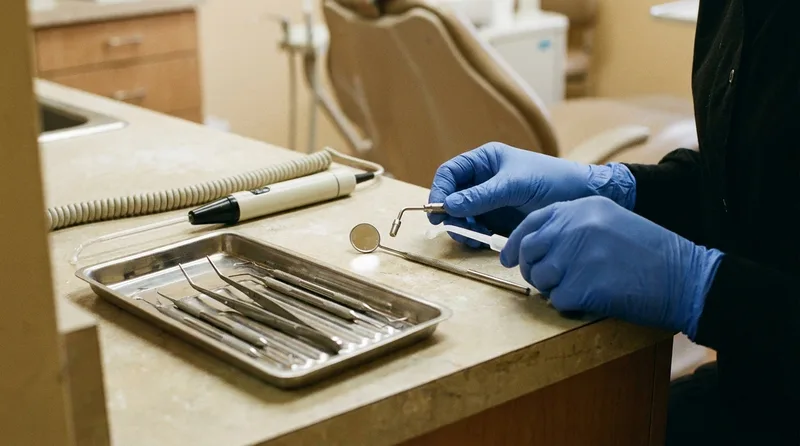
Here's the sequence a typical visit follows:
- Symptom history. How long, how sharp, how long it lingers, whether cold or biting also register.
- Visual and tactile exam. Checking restoration margins, gumline notching, and any visible soft spots.
- Bitewing X-rays. The standard way to find decay between teeth and beneath existing fillings.
- Cold testing. Applied tooth by tooth. A response that fades in a second or two suggests healthy nerve tissue; one that lingers past thirty seconds suggests the nerve is inflamed.
- Bite stick test. Isolates each cusp to find the one that moves.
- 3D imaging when needed. Our iCAT 3D imaging shows the tooth and surrounding bone from any angle, which helps when a flat X-ray leaves questions unanswered.
Regular dental visits can catch 80% of oral health issues before they become serious, according to the ADA. Sweet sensitivity in one tooth is precisely the kind of early signal that testing turns into an answer, usually within a single appointment.
Same-day appointments are available in Wylie
Willow Family Dentistry keeps room in the schedule for reactive teeth. Our team also speaks Korean, Spanish, and Vietnamese.
Book Your Visit →What Are the Treatment Options for One Sensitive Tooth?
Treatment follows the diagnosis rather than the symptom. A leaking filling gets replaced, decay gets restored, a cracked cusp gets covered, and an exposed root gets sealed or grafted. Most single-tooth cases are handled in one visit, though deeper involvement can require two.
The realistic range of options:
- Fluoride varnish or a desensitizing agent. Useful for mild root exposure with no decay. Applied in minutes, repeated at recall visits.
- Composite bonding. Seals a worn notch at the gumline and covers the exposed dentin.
- Tooth-colored filling. The standard answer for a cavity or a failing older restoration.
- Onlay or crown. Needed when a cusp is cracked or too little healthy structure remains to support a filling. A porcelain crown wraps the tooth so the crack can no longer flex open.
- Root canal therapy. Reserved for cases where the nerve is already irreversibly inflamed, which sweet sensitivity alone rarely indicates.
- Gum grafting. Considered when recession is significant and likely to continue.
If dental visits make you tense, that's worth saying out loud when you book. Research published in BMC Oral Health in 2024 found that 36% of Americans have dental anxiety and 12% have extreme dental fear, so the reaction is common rather than unusual. Willow Family Dentistry offers both nitrous oxide and IV sedation, and Dr. Jeong's approach is judgment-free regardless of how long it's been since your last visit.
When Should You See a Dentist in Wylie, TX About It?
Book an appointment if the sensitivity has lasted more than two weeks, is getting stronger, or lingers well after the sweet is gone. Those three patterns separate a tooth that needs treatment from one that's simply settling after recent work, and none of them improve with waiting.

Certain signs deserve a same-day call rather than a routine booking:
- Discomfort that lingers longer than thirty seconds after the trigger is removed
- An ache that starts on its own, with no sweet or cold involved
- Anything that wakes you at night
- Visible swelling of the gum or face
- A persistent bad taste, which can indicate drainage from an infection
- The tooth feels loose or noticeably higher when you bite
That last group points toward the nerve rather than the surface. Dental abscesses can spread to other parts of the body within 48 hours if untreated, according to JADA, which is why swelling and spontaneous aching move a tooth from the routine column into the emergency dental care column. Willow Family Dentistry reserves same-day slots for exactly these situations.
Short of that, a standard appointment within a week or two is appropriate. Bring specifics: which tooth, what sets it off, and when it started. That history shortens the diagnostic process.
What Should You Do Before Your Appointment?
Keep the tooth clean and stop testing it. Many people repeatedly poke a reactive tooth with sugar or cold to check whether it still responds, which only keeps the nerve irritated. Gentle care and a short symptom log will serve you far better in the meantime.
A few things that help in the days before your visit:
- Switch to a soft-bristled brush and lighten your pressure, particularly at the gumline.
- Try a desensitizing toothpaste containing potassium nitrate or stannous fluoride. Give it two weeks; it works by gradually calming the nerve.
- Chew on the opposite side if the tooth reacts to biting, which reduces flexing if a crack is present.
- Write down the trigger, the intensity, and how long the sensation lasts each time. Patterns you notice at home are diagnostic information.
What won't help: placing aspirin against the gum, which burns the tissue. Americans who visit a dentist regularly are 60% less likely to lose teeth, per the Journal of Dental Research. That gap comes almost entirely from acting on early signals.
The most useful thing about having one tooth sensitive to sweets is how specific it is. A single reactive tooth narrows the search dramatically compared with vague, spread-out sensitivity, and specificity is what makes a short appointment and a small restoration possible instead of a long one.
Your next step is straightforward: get that one tooth tested. Note which tooth it is, what triggers it, and how long the sensation hangs around, then bring that to a visit. Call Willow Family Dentistry at (972) 881-0715 or request an appointment online.
Results may vary. Please consult with Dr. Jeong for personalized treatment recommendations.
Get That One Tooth Looked At
Dr. Esther Jeong will test the tooth, review your imaging, and explain what she finds in plain language. No lectures, no upselling.
Request an Appointment →Prefer to talk it through first? Call the Wylie office at (972) 881-0715.
Meet Dr. Jeong →Dr. Esther B. Jeong, DDS
DDS · Willow Family Dentistry
Wylie family dentist with 15+ years of experience providing gentle, judgment-free dental care.
Frequently Asked Questions
Was this article helpful?
You may also like


Have a dental question?
Schedule a consultation and get personalized answers from Dr. Jeong.
Call us
(972) 881-0715
Hours
Mon – Thu: 9am – 5pm
Fri: By Appointment
Location
1125 W FM 544, Wylie
Emergency? Same-day appointments available.