
Gum Disease and Heart Disease: What Your Dentist Knows
9 min read
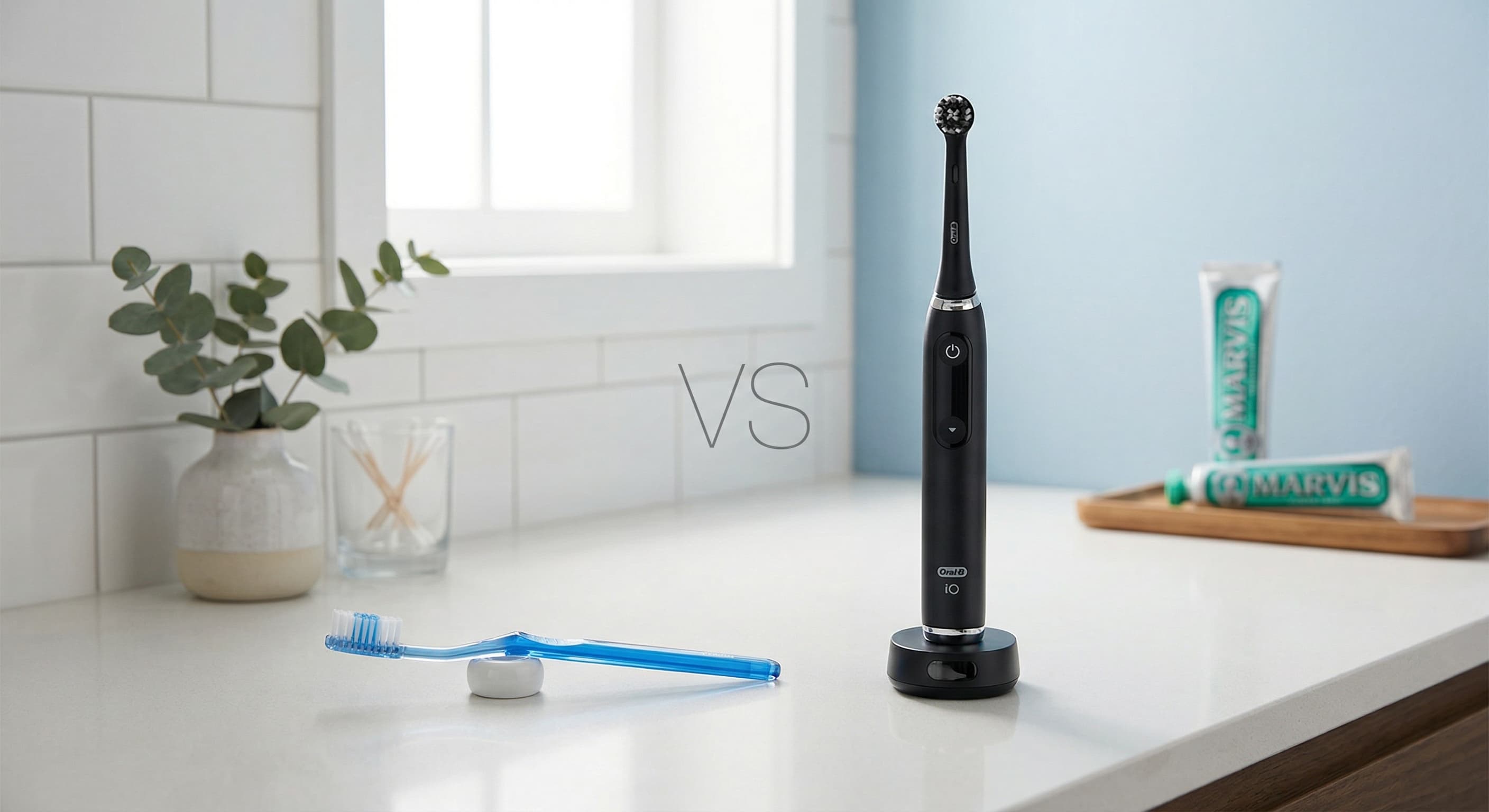
You've stood in the toothbrush aisle at least once, staring at a $6 manual brush next to a $200 electric model, wondering if the price tag actually means cleaner teeth. You're not alone. The electric vs manual toothbrush debate is one of the most common questions families ask at Willow Family Dentistry in Wylie, Texas. And the answer isn't as straightforward as the marketing would have you believe.
Here's what we'll cover: what the clinical research actually says, which brush type works best for different age groups and situations, and how to get the most from whichever option you choose. Whether you're buying for yourself or outfitting your whole household, this guide gives you the facts without the sales pitch.
Electric toothbrushes remove significantly more plaque than manual brushes in most clinical studies, with research showing a 21% greater reduction in plaque and 11% greater reduction in gingivitis over a three-month period. That said, a manual brush used with proper technique still does an excellent job.
A landmark Cochrane systematic review analyzed 56 clinical trials comparing the two brush types. The findings were clear: oscillating-rotating electric brushes consistently outperformed manual brushes. But context matters here. Those studies measured average performance across large groups. Individual results depend heavily on brushing technique, duration, and consistency.
The American Dental Association accepts both electric and manual toothbrushes with the ADA Seal of Acceptance. Their position? Either type can work well. The best toothbrush is the one you'll actually use correctly, twice a day, for two full minutes. Regular dental visits can catch 80% of oral health issues before they become serious, according to the ADA, so your brushing tool is just one piece of the picture.
What the research doesn't always capture is real-world behavior. Most people brush for about 45 seconds with a manual brush. Not two minutes. Electric brushes with built-in timers solve that problem automatically.
Keeping Your Smile Healthy Starts with Prevention
Regular checkups and cleanings help you get the most from your daily brushing routine, no matter which brush you prefer.
Learn About Preventive Care →Electric toothbrushes offer the biggest advantage for people with limited dexterity, children who are still learning proper technique, orthodontic patients, and anyone who tends to brush too hard. For these groups, the technology compensates for common brushing mistakes.
Consider a few specific scenarios. A 70-year-old patient in Murphy with arthritis can't grip a thin manual brush handle or make the small circular motions needed for effective cleaning. An electric brush does that motion for them. Similarly, kids ages 6-12 often lack the fine motor skills for thorough manual brushing. Nearly 20% of children ages 5-11 have at least one untreated decayed tooth, according to the CDC. An electric brush can help close that gap.
If you're wearing clear aligners or have brackets and wires, plaque builds up fast around attachment points. Electric brushes, especially those with orthodontic brush heads, reach areas that manual bristles miss. Clear aligner patients at our Wylie office often find that a small oscillating brush head cleans around aligner attachments more thoroughly.
Here's something most people don't realize. Brushing harder doesn't mean brushing better. It often means damaged enamel and receding gums. Many electric models include pressure sensors that alert you when you're pushing too hard. That single feature prevents a surprising amount of long-term damage.
A manual toothbrush is the better choice when you have good brushing technique, prefer simplicity, travel frequently, or are working within a tight budget. Manual brushes also give you complete control over pressure and angle, which some patients prefer.
Don't underestimate the manual brush. It's been doing the job for decades. A soft-bristled manual toothbrush with a small head, used with the modified Bass technique (angling bristles 45 degrees toward the gumline with short back-and-forth strokes), removes plaque effectively. The key word is "technique."
Cost is a real factor for families. A family of four in Sachse buying manual brushes every three months spends roughly $30-40 per year. Outfitting that same family with electric brushes means $200-800 upfront, plus $40-80 annually for replacement heads. That's a meaningful difference. And if everyone in the house brushes properly for two minutes? The clinical gap between the two narrows considerably.
Travel is another consideration. Manual brushes are lighter, don't need charging, and you won't lose sleep if one gets left behind at a hotel. For frequent travelers, keeping a manual brush in your bag and an electric one at home is a practical compromise.
Related: Good brushing habits start young, and so should dental visits. → How Often Kids Need Dental Checkups
Not all electric toothbrushes are equal. Oscillating-rotating brushes have the strongest clinical evidence, while sonic brushes use high-frequency vibrations to create fluid dynamics that may clean slightly below the gumline. Your choice depends on your specific oral health needs and personal comfort.
| Feature | Oscillating-Rotating | Sonic | Manual |
|---|---|---|---|
| Plaque Removal | Excellent (most studied) | Very Good | Good (technique-dependent) |
| Gum Health Impact | 11% reduction in gingivitis | Comparable in some studies | Effective with proper angle |
| Built-in Timer | Yes (most models) | Yes (most models) | No |
| Pressure Sensor | Mid-to-high-end models | Mid-to-high-end models | No |
| Annual Cost (per person) | $50-200 first year, $15-25 after | $50-300 first year, $20-40 after | $8-12 per year |
Here's something worth knowing. The Cochrane review specifically found the strongest evidence for oscillating-rotating models. Sonic brushes have good data too, but the research base is smaller. Both outperform manual brushes in studies where participants use them consistently. Advanced diagnostic technology like iCAT 3D imaging at our office can actually show us whether your current brushing method is reaching all surfaces effectively.
Price doesn't always equal performance. A $50 oscillating brush often cleans just as well as a $250 model with Bluetooth connectivity and AI coaching. The extras are nice. They're not necessary.
Not Sure Which Brush Is Right for Your Teeth?
Dr. Esther Jeong and our team can assess your brushing technique and recommend the best option for your oral health goals.
Request an Appointment →Your brushing technique, duration, and frequency matter far more than whether you use an electric or manual toothbrush. The most common mistakes we see at our Wylie office are brushing for less than two minutes, using too much pressure, and neglecting the gumline and back molars.
Let's put this in perspective. Nearly 1 in 4 adults in the United States has untreated tooth decay, according to CDC data. That's not because they all chose the wrong toothbrush. It's because of inconsistent habits and skipped dental visits. Americans who visit a dentist regularly are 60% less likely to lose teeth, according to the Journal of Dental Research.
One thing we tell Allen and Plano families who visit our office: flossing and brushing work as a team. No toothbrush, electric or manual, can clean between teeth where cavities frequently start. If you're only doing one, you're leaving roughly 35% of tooth surfaces untouched.
For children under 6, a manual toothbrush with a small head and soft bristles is usually the best starting point, since parents should be doing most of the brushing anyway. After age 6, an age-appropriate electric toothbrush can make brushing more engaging and effective, especially for kids who resist the routine.
Tooth decay is the most common chronic disease in children, five times more common than asthma, according to the ADA. That statistic surprises most parents. Getting brushing right early matters enormously. The ADA recommends a child's first dental visit by age 1 or when the first tooth appears, and pediatric dental care at our Wylie office includes personalized brushing guidance for every age group.
Families near Wylie High School and throughout the Wylie area bring their kids to our office for their first cleanings, and we always assess brushing habits as part of the visit. Dental sealants can reduce the risk of cavities in school-age children by nearly 80%, per the CDC, and we often recommend them alongside good brushing routines for extra protection.
Gentle, Fun Dental Visits for Kids of All Ages
Our dedicated play area and friendly team make checkups something your child might actually look forward to.
Explore Pediatric Dentistry →Yes, your toothbrush type can influence gum health over time. Electric toothbrushes, particularly oscillating-rotating models, show measurably better results for reducing gingivitis and early-stage periodontal disease compared to manual brushing in long-term studies.
A 2019 study published in the Journal of Clinical Periodontology followed nearly 2,800 adults over 11 years. Electric toothbrush users had 22% less gum recession and 18% less tooth loss compared to manual-brush users. That's an 11-year study. Not a six-week marketing trial.
Why the difference? Two reasons. First, electric brushes maintain consistent motion even when you're tired, distracted, or rushing. Second, the pressure sensors on many models prevent the aggressive scrubbing that accelerates gum recession. Your gums don't regenerate on their own once they've receded. Prevention is the only real option there.
For patients already dealing with gum issues, we often recommend electric brushes as part of a broader periodontal treatment plan. But the brush alone isn't enough. Professional cleanings, proper flossing, and sometimes scaling and root planing are all part of the equation. At Willow Family Dentistry on W FM 544, Suite 700 in Wylie, we use iCAT 3D imaging to evaluate bone levels and catch periodontal issues that aren't visible to the eye.
The bottom line on gum health: an electric toothbrush gives you an edge, but it's your overall routine, including regular dental visits, that determines outcomes.
The electric vs manual toothbrush question doesn't have one right answer for every person. What matters most is consistency: two minutes, twice a day, with the right technique and regular professional care to catch what you miss at home. If you're unsure whether your current routine is working, bring your toothbrush to your next appointment. We'll show you exactly what's working and what isn't, with zero judgment.
Ready for a Personalized Brushing Assessment?
Our Wylie dental team will evaluate your brushing technique and recommend the best tools for your smile. Families from Wylie, McKinney, Lucas, and beyond are welcome.
Request an Appointment →Have Questions? We're Happy to Help.
Contact Willow Family Dentistry →Dr. Esther B. Jeong, DDS
Owner & Lead Dentist
Was this article helpful?
Schedule a consultation and get personalized answers from Dr. Jeong.
Call us
(972) 881-0715
Hours
Mon – Thu: 9am – 5pm
Fri: By Appointment
Location
1125 W FM 544, Wylie
Emergency? Same-day appointments available.